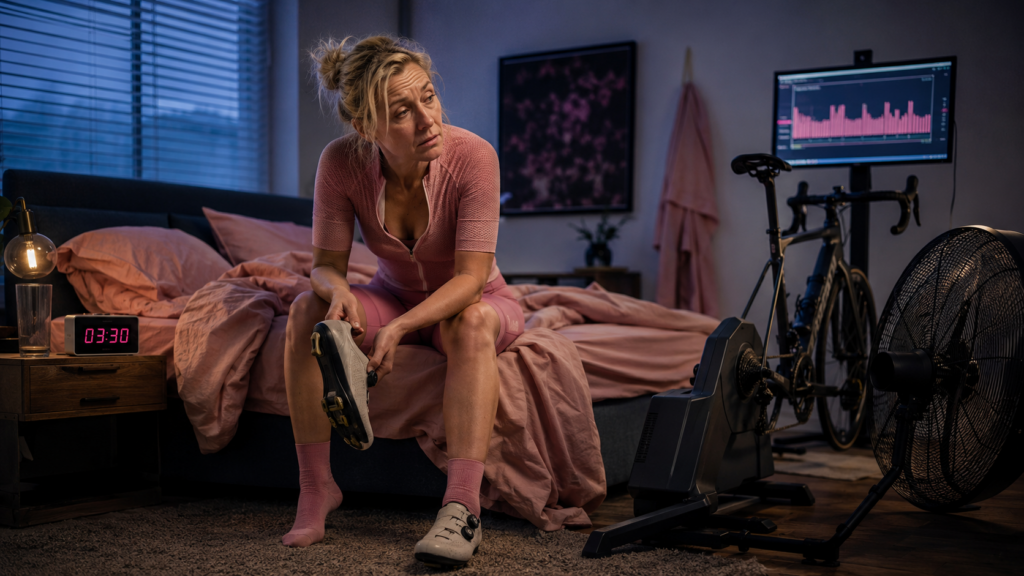
Half past three in the morning, wide awake, doing sums.
If I fall asleep right now, I still get four hours. Three and a half. Three, if I keep lying here calculating instead of sleeping. And then the alarm goes at five for a session I’d been quite looking forward to, and I get on the bike already knowing it’s going to be rubbish.
Then, twenty minutes in, watching the numbers, the confusing bit: the watts are fine. They’re right where they should be. It just feels absolutely horrendous. 🙃
That gap — between what the screen says and what your legs are telling you — turns out to be the whole story.
Poor sleep can affect effort and performance Sources: Kong et al. (2025), systematic review.
This surprised me when I read it properly, and it’s the single most useful thing in this article.
Sleep loss can affect both how hard exercise feels and what you can sustain. Effects vary with the amount of sleep lost, the task and the individual; normal-looking watts do not prove that you are recovered. Sources: Kong et al. (2025), systematic review; Walsh et al., athlete sleep consensus.
Sleep loss can increase perceived effort and reduce performance. A 2025 review of 45 studies found effects across several performance measures, with variation between tests and sleep-loss protocols. That does not predict a fixed loss for every rider after one poor night. Sources: Kong et al. (2025), systematic review.
On Zwift, the power number is useful information, but it does not tell you how well you have recovered. An unusually hard-feeling interval is a reason to reassess the session, not proof that you should ignore your body. Sources: Kong et al. (2025), systematic review; Walsh et al., athlete sleep consensus.
Poor sleep can make the same effort feel harder and can reduce performance. Treat both the numbers and how you feel as information. Sources: Kong et al. (2025), systematic review; Walsh et al., athlete sleep consensus.
Which explains something that used to genuinely bother me: how I could have a session that felt like the worst ride of my life, only to look at the file afterward and see perfectly respectable numbers. I wasn’t imagining the suffering. I just wasn’t losing what I thought I was losing.
Why did the sleep go in the first place
Sleep disruption in midlife can have several contributors. Sources: NHS — Menopause and perimenopause symptoms.
Sleep problems can occur during perimenopause and menopause. Hormonal changes, symptoms and other causes may contribute; a broken night alone does not identify the cause. Sources: NHS — Menopause and perimenopause symptoms.
Night sweats and hot flushes can interrupt sleep. If they are affecting you, discuss the symptoms and possible treatments with a healthcare professional. Sources: NHS — Menopause and perimenopause symptoms.
Fragmented sleep can leave you tired even after enough time in bed. It does not tell you which sleep stage was lost. Sources: CDC — About Sleep.
Poor sleep is one possible contributor to difficult recovery; it is not the only explanation. Sources: Walsh et al., athlete sleep consensus.
I’m not going to give you a sleep hygiene lecture
You know the list. Dark room, cool room, no screens, no wine, consistent bedtime, no caffeine after lunch.
Sleep habits can help, but persistent sleep problems or disruptive night sweats may need assessment and treatment as well. Sources: CDC — About Sleep; NHS — Menopause and perimenopause symptoms.
The honest position is this: a fair amount of this sleep disruption isn’t something you can fix by being more disciplined about it. Trying harder to sleep can make it harder to drift off. And spending your energy chasing the perfect night is energy you could be spending on the part you actually control.
Which is the training.
What to do with the session after a bad night?
After a broken night, reassess what you ask of the session. An easy ride or rest may be more appropriate than the planned hard workout. Sources: Kong et al. (2025), systematic review; Walsh et al., athlete sleep consensus.
Reassess: easy riding or rest 🔄 Sources: Walsh et al., athlete sleep consensus.
If you are unusually tired, swap the hard session for an easy one or rest. Reassess before rescheduling the intervals; do not squeeze them into the next day just to catch up. Sources: Kong et al. (2025), systematic review; Walsh et al., athlete sleep consensus.
Use power alongside how you feel ⚡ Sources: Kong et al. (2025), systematic review.
Use power alongside how you feel. If you are unusually tired, swap the hard session for an easy one or rest, rather than forcing a target. Sources: Kong et al. (2025), systematic review; Walsh et al., athlete sleep consensus.
A respectable power file does not cancel out unusual fatigue. You do not need to force an interval to prove that your fitness is still there. Sources: Kong et al. (2025), systematic review; Walsh et al., athlete sleep consensus.
Adjust duration, intensity, or rest ✂️ Sources: Walsh et al., athlete sleep consensus.
A shorter session is an option if you feel well enough, but there is no requirement to preserve the intensity. If even an easy effort feels unusually difficult, stop and rest. Sources: Kong et al. (2025), systematic review; Walsh et al., athlete sleep consensus.
Nap if you can, honestly 😴
A nap may help with daytime sleepiness, but it is not a guaranteed replacement for lost night-time sleep. Avoid a nap that makes it harder for you to sleep at night. Sources: Walsh et al., athlete sleep consensus; NIH NHLBI — Healthy sleep habits.
Stop judging the week by its worst day 📉
One horrible session after one horrible night is not a fitness trend. It’s a Tuesday. The mistake I kept making was treating a bad ride as evidence of my fitness rather than of my night.
🩷 See the connection for yourself
The Perimenopause Training Tracker lets you record sleep, symptoms, energy and sessions side by side, so you can look for patterns between sleep, symptoms and training. A journal can suggest possible patterns; it does not establish what caused a difficult session.
The bit worth saying out loud
If sleep problems persist or affect your daily life, speak to a healthcare professional. You do not need to wait months to ask for help. Sources: CDC — About Sleep.
Night sweats can often be treated. Sleep that’s broken for other reasons can be investigated. Snoring that leaves you exhausted despite eight hours in bed is worth mentioning to a doctor. A lot of women spend years assuming this is simply the deal now, and for a decent number of them it isn’t.
Go and have the conversation. Worst case, you’ve had a conversation. 🩷
A difficult session after poor sleep is not, on its own, evidence that you have lost fitness. Use the ride file alongside your symptoms and recovery; resting or adjusting the session can be the right decision. Sources: Kong et al. (2025), systematic review; Walsh et al., athlete sleep consensus.
This is the last in the run I’ve been writing on training through perimenopause. If you’ve come in at the end, start with the fuller picture for South African women, then move to recovery, strength, and overheating. And if you want the cycle-tracking angle, this one is about how your cycle affects your Zwift power.
One tired session is not a reliable verdict on your fitness. Sources: Walsh et al., athlete sleep consensus.

🩷The Endurance Diaries🩷