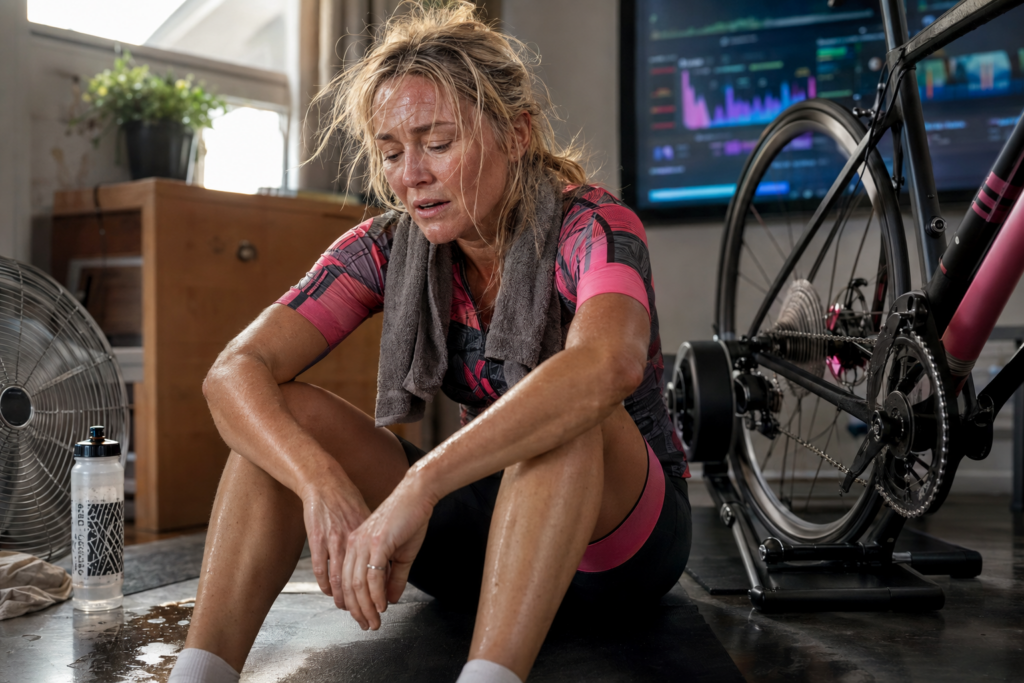
For about eighteen months, I thought I was just getting unfit.
Not dramatically. Not in a way anybody else would have noticed. Just… slightly worse, in a way that didn’t seem to respond to anything. The same Tuesday session that used to leave me tired now left me flattened until Thursday. My legs felt heavy on days they had no business feeling heavy. And the thing that really got me was that I’d do everything right — sleep, eat, take the rest day — and still turn up on Saturday feeling like I’d been awake for a week.
So I did what most of us do. I assumed I wasn’t trying hard enough, and I trained harder. 🙃
That went about as well as you’d expect.
It isn’t that you’ve stopped being fit
Here’s the part nobody sat me down and explained.
Perimenopause isn’t a tidy downward slope. It’s not your hormones politely declining in a straight line until one day you’re through it. It’s erratic. Estrogen can spike high one month and drop off a cliff the next, and progesterone often falls away earlier and faster. That’s why the experience feels so maddeningly random — one week you’re flying, the next week the same session on the same bike at the same watts feels like someone’s filled your legs with wet sand.
And estrogen isn’t only a reproductive hormone. It’s involved in how muscle repairs itself after you’ve broken it down, how your connective tissue holds up, how you regulate temperature, how you sleep, and how your body handles fuel during a hard effort. When it’s swinging around unpredictably, all of those get less reliable at once.
So the training stress you’re putting in is the same. The recovery you’re getting back from it isn’t. That’s the whole thing, really. Same input, less repair, and the gap quietly compounds week after week until you’re sitting on the edge of the bed at 5am wondering what happened to you.
You haven’t lost your fitness. You’ve lost some of your recovery capacity — and those are two completely different problems with two completely different fixes.
Stop counting sessions. Start counting hard days.
The single change that made the biggest difference for me had nothing to do with training less. It was about how the week was arranged.
Most of us build a week by counting sessions. Five rides. Three runs. Whatever the number is, we feel good when we hit it and guilty when we don’t. But the number of sessions isn’t what’s breaking you — it’s how many genuinely hard days you’re asking your body to absorb, and how close together they are.
Try this instead. Go through your week and mark every session as one of three things:
- Hard — intervals, a race, a long ride or run, anything that leaves a mark 🔴
- Steady — comfortable, conversational, you finish feeling better than you started 🟢
- Easy — genuinely easy, and yes it should feel almost embarrassingly slow 🩵
Now count the reds. For most of us in this stage, two hard days a week are plenty, and three is the ceiling. What matters just as much is spacing — put at least 48 hours between them, and don’t let two land back-to-back just because that’s how the week fell.
When I did this properly the first time, I found four hard days a week I’d describe as “moderate”. Four. No wonder I was cooked. Half of them weren’t even planned as hard sessions — they’d just crept up in intensity because I felt behind and pushed.
Let the hard day move
This is the bit that felt like cheating until I realized it was just sensible.
A training plan written on a Sunday has no idea what kind of night you’re going to have on Wednesday. And through perimenopause, the nights are the variable. Broken sleep, night sweats, waking at 3am for no reason at all — and deep sleep is exactly when a lot of your physical repair happens. Turning up to a threshold session on four fragmented hours isn’t discipline. It’s just paying full price for a fraction of the adaptation.
So don’t cancel the hard session. Move it. Swap Wednesday’s intervals with Thursday’s easy spin and carry on. The week keeps its shape, you keep the session, and you do it on a day your body can actually use it.
Two things make this much easier. The first is tracking—not obsessively, just enough to see your own patterns. Once you can see that you consistently feel rubbish in a particular stretch of the month, you stop taking it personally and start planning around it. I’ve written before about how your cycle affects your Zwift power, and the same logic applies here, just messier — the cycle itself gets less predictable, so you’re tracking how you feel more than what the calendar says.
The second is giving yourself permission in advance. Decide on Sunday that the week can be shuffled. That way, when Wednesday goes badly, you’re following the plan rather than failing it. 🩷
The two things worth adding
I resisted both of these for ages because neither one is riding or running, and I wanted to spend my limited time doing the sport I actually like. I was wrong about both.
Strength work, twice a week
Resistance training is one of the few things with genuinely strong evidence behind it for this stage of life — for muscle, for bone density, and for the tendons and connective tissue that start complaining more than they used to.
You do not need a gym membership or a barbell. You do not need to be lifting heavy to benefit, and on a bad-sleep week, heavy lifting carries a recovery cost that might not be worth it. Two sessions of twenty to thirty minutes, done consistently, will do more for you than an ambitious program you abandon in three weeks. Squats, step-ups, hinges, something overhead, something for your core. Done.
More protein, spread throughout the day
Because muscle repair gets less efficient when your hormones are all over the place, the general advice for women in perimenopause is more protein than standard guidelines suggest — and more importantly, spread across your meals rather than piled into supper.
The specific numbers vary quite a bit depending on who you ask and what your training load looks like, which is a conversation worth having with a dietitian rather than with the internet. But the practical version is simple enough: get some protein into breakfast, which most of us skip entirely. I’ve written more about the fuelling side in why food is half your training plan, and there are budget recovery meals here if you want something practical and SA-priced.
🩷 Stop guessing at your own patterns
The Perimenopause Training Tracker is the tool I wish I’d had during those eighteen months. It logs sleep, energy, symptoms, and session quality side by side, so after a few weeks you can actually see your pattern instead of trying to remember it. That’s what turns “I feel rubbish again” into “right, this is the week I move the hard sessions.”
What I’d tell myself eighteen months ago
That the tiredness was information, not a character flaw. The answer to feeling flat was almost never going to be another hard session. And that adjusting the week wasn’t the beginning of giving up — it was the thing that let me keep going.
I’m still riding. I’m still racing. Some weeks are still rubbish, and I’ve stopped expecting them not to be. But I’m no longer spending Tuesday to Thursday wondering what’s wrong with me, and that alone has been worth the entire rearrangement.
If you’re somewhere in this and it’s been going on a while — especially if the fatigue is severe, your sleep has genuinely fallen apart, or something just feels off in a way this article doesn’t cover — please go and talk to a doctor who takes women’s health seriously. There are more options than most of us are told about, and none of this is something you have to simply push through on your own.
And if you’re at the start of all this and want the fuller picture, I’ve written about perimenopause and endurance training for South African women — the one I wish somebody had handed me first. If it’s the coming-back part you’re stuck on, getting back on the bike after a break covers that side of it.
You’re not training around a broken body. You’re training around a changing one — and that’s a much better problem to have.

🩷The Endurance Diaries🩷