The first time it properly happened, I genuinely thought my fan had packed up.
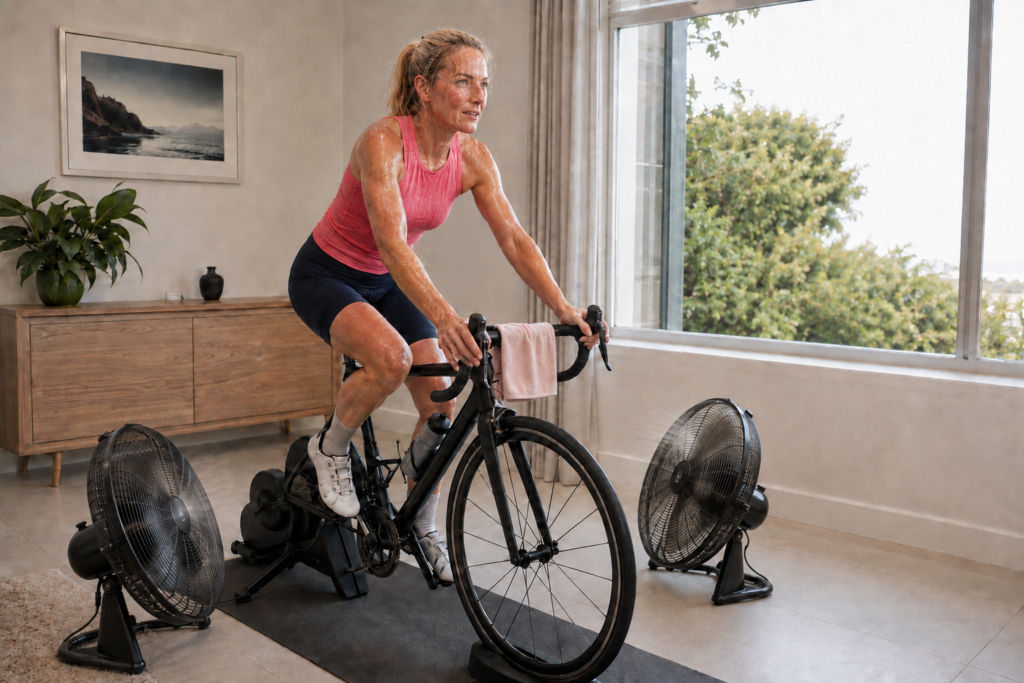
Forty minutes into a session I’d done a hundred times, on a mild evening, with the same fan in the same spot — and I was cooking. Not pleasantly warm. Not working hard, warm. Properly overheating, in a way that made the last twenty minutes feel like a completely different session to the one I’d started.
I got off, checked the fan, and it was working perfectly. 🙃
It took me an embarrassingly long time to connect that with everything else that was going on.
First, the trainer is genuinely working against you
Before we get to hormones, it’s worth saying that indoor riding is uniquely brutal in a way outdoor riding simply isn’t — and this catches everybody out, at every age.
Outside, you’re moving through air. Even at a modest pace, that airflow constantly strips heat from your skin and evaporates sweat, which is how sweating actually cools you. Indoors, you go precisely nowhere. There is no airflow unless you create it. The air around you warms as you heat it, and sweat that doesn’t evaporate does absolutely nothing for you except make a mess.
That’s why I bang on about fans in every beginner indoor cycling piece I write. A fan isn’t a comfort item. It’s the closest thing you have to replacing the wind.
So if you’re new to the trainer and melting — that’s normal, and it’s fixable with airflow. But if you’ve been riding indoors happily for years and something has recently changed, keep reading.
What’s actually changed — and it isn’t your fitness
Your body has a comfortable temperature range that it tries to stay within. Go above the top of it, and you start sweating. Drop below the bottom, and you start shivering. The gap between those two points is your thermoneutral zone, and for most of your life it’s reasonably wide — a bit of a buffer before your body does anything dramatic.
Estrogen is involved in setting that range. As it begins to fluctuate and decline, the best current understanding is that the zone narrows — in some women, dramatically. The buffer shrinks. So a rise in core temperature that would previously have gone completely unnoticed now tips you straight past the threshold and into full-blown heat-dissipation mode.
And here’s the finding that made me sit up. In one study that measured this properly, when women with hot flushes exercised, every single one of them experienced a flush during the session. None of the symptom-free women did.
Exercise raises your core temperature. That’s what it does. If your buffer has shrunk, exercise becomes one of your most reliable triggers.
You haven’t got worse at handling heat. Your margin got smaller — and the trainer, which was always warm, is now landing on the other side of a line that used to be further away.
Two things worth being straight about. Most of this research was done on postmenopausal women rather than women in the thick of perimenopause, and researchers are still arguing about the exact mechanism. So this is the best current understanding, not a settled fact.
But the practical picture — narrower margin, higher sweat rate, exercise as a reliable trigger — matches what an awful lot of us are experiencing on the trainer. And it’s enough to work with.
What actually helps
Not “push through it”. Not “you’ll get used to it”. Actual things that make a measurable difference, roughly in order of how much they’ve helped me.
1. Fix the fan properly 🌬️
Most of us have a fan. Most of us have it in the wrong place, doing about a third of the job.
- Aim it at your chest and face, not your legs. That’s where the cooling happens.
- Get it close and get it high — on a chair or a box, not on the floor pointing at your ankles.
- A second fan changes everything. One on your front, one from the side. This was the single biggest upgrade I made, and neither of mine is expensive or clever.
- Open a window or door for actual air exchange. A fan recirculating hot air in a sealed room is just moving your own heat around.
2. Start colder than feels sensible 🧊
Pre-cooling genuinely works, and it’s free. Cold shower before you ride. Cold drink in hand at the start rather than when you’re already suffering. Start the session slightly chilly and let the ride warm you up, instead of starting comfortable and climbing from there.
A frozen bottle you can hold against your neck or wrists mid-session is worth more than it sounds. So, put a wet cloth in the freezer before you start.
3. Wear less, and wear the right less 👕
Nobody’s watching. A vest and shorts are a completely legitimate indoor kit choice. Whatever you wear, make sure it’s something sweat can actually evaporate through — a soaked cotton t-shirt is basically insulation at that point.
4. Match fluids to your needs 💧 Sources: NATA — Fluid replacement position statement; AIS — Electrolyte supplement considerations.
Fluid needs vary with session length, intensity, room conditions and your sweat losses. Keep drinks within reach; thirst is a useful guide for many recreational sessions. For prolonged or demanding sessions, a sports dietitian can help you plan fluid and sodium replacement. Water may be enough for shorter sessions; an electrolyte tablet is not automatically necessary. Avoid forcing fluids beyond your losses: adding electrolytes does not make overdrinking safe. Sources: NATA — Fluid replacement position statement; AIS — Electrolyte supplement considerations.
5. Move the hard sessions to the cool part of the day ⏰
Obvious once you say it, but a lot of us do the hard session whenever there’s a gap. If your options are 6pm on a warm afternoon or early morning, the early morning session will feel like a different sport.
6. Stop reading it as weakness 🩷
This one isn’t practical, but it might be the most useful. When you know the overheating is a thermoregulation thing rather than a fitness thing, you stop interpreting it as evidence you’ve gone soft — and you stop pushing harder to prove otherwise, which only makes the whole thing worse.
🩷 Find your own pattern
Overheating isn’t random, even when it feels like it. It tends to cluster — around certain points in your cycle, after bad sleep, at particular times of day. The Cycle Performance Tracker logs your sessions alongside symptoms, sleep, and energy, so after a few weeks, you can look for patterns in when overheating happens and use those observations when planning your sessions.
The genuinely good news
Here’s the bit I wasn’t expecting when I started reading about this properly.
Regular endurance training appears to improve thermoregulation — and there’s research suggesting exercise training reduces how often and how severely women get hot flushes by making the whole cooling system work better and kick in earlier.
Which is a bit of a plot twist. The thing making your sessions miserable right now is also, over weeks and months, one of the things that helps. Not immediately, and not in a way you’ll notice on Tuesday. But the consistent riding isn’t just something you’re enduring despite the flushes. It’s part of the answer.
That reframe kept me on the bike through a rough few months, and I’ll take it.
If you feel dizzy, nauseated or unwell in the heat, stop exercising and cool down. Signs of heatstroke, such as confusion, seizures or loss of consciousness, require immediate emergency medical help. Do not wait to see whether cooling helps before calling for emergency help when these signs are present. Begin cooling while help is on the way. If you remain unwell after 30 minutes of resting in a cool place, cooling and drinking fluids, seek emergency medical help even without those signs. Do not try to treat these symptoms by forcing more water or waiting for another episode. Sources: NHS — Heat exhaustion and heatstroke.
If this is all landing a bit close to home, this is the fuller picture on perimenopause and endurance training, and I’ve written about restructuring your week when recovery takes longer and why strength work matters more than it used to.
Buy the second fan. Honestly. It costs less than a decent pair of bib shorts and it will change more sessions than the shorts ever will.

🩷The Endurance Diaries🩷