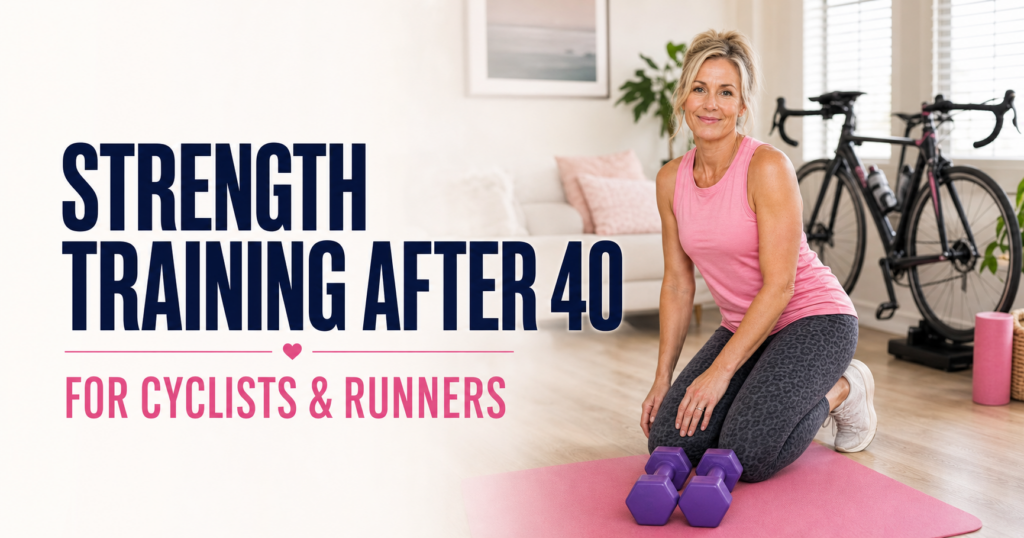
Strength training was the thing I skipped for years, and I had excellent reasons.
I had limited time, and I wanted to spend it doing the sport I actually enjoy. Squats have never once given me the feeling I get halfway up a climb. And somewhere in the back of my head was the idea that strength work was for people who were serious about it — the ones with a proper program and a gym membership and the right shoes for it.
Then I turned forty-something, started reading properly about what happens to women’s bodies in this stretch, and found out that the thing I’d been skipping is arguably the single most useful thing I could be doing. 🙃
Annoying. But here we are.
Why it matters more now than it did at thirty
I wrote last week about how recovery changes through perimenopause, and this is the other side of the same coin.
Estrogen isn’t just involved in recovery. It’s involved in how muscle is built and maintained, how bone 🦴 is maintained, and how tendons and connective tissue stay resilient. When it starts swinging around and trending downward, all three of those get harder to hold on to — and the endurance training we love doesn’t do much to protect any of them.
That’s the uncomfortable bit. Riding and running are brilliant for your heart, your head, your fitness, and your sanity. They are not, on their own, doing much for the muscle you’re losing or the bone 🦴 you’re thinning. Those need a different kind of stress.
The good news, and it is genuinely good news, is that resistance training is one of the few things in this whole conversation with really solid evidence behind it. Not a supplement, not a gadget, not a protocol you have to buy. Just picking heavy-ish things up, a couple of times a week, consistently.
The bit that genuinely surprised me: cycling doesn’t build bone🦴
I had somehow assumed that being fit and active meant my bones 🦴 were fine. Turns out that depends quite a lot on which sport you’re fit for.
Bone 🦴 responds to load and impact. Every running stride sends a force through your skeleton that tells it to keep hold of what it’s got. Cycling sends almost nothing. You’re seated, the bike is carrying you, and there’s no impact at all — which is exactly why we love it when our knees are sore, and exactly why it does nothing for bone.
The research on this is fairly striking. Studies comparing cyclists to runners have repeatedly found significantly lower bone 🦴 mineral density in cyclists — one frequently cited study found that competitive cyclists were about seven times as likely to have spinal thinning as runners of similar age and body weight.
Two honest caveats before anybody panics. First, that research is largely done on high-volume competitive cyclists, and much of it on men. Recreational riders show far less of a difference. Second — and this is the important one — if you still run two or three times a week alongside your riding, you’re getting the bone-loading 🦴 stimulus, and you’re largely fine.
But read that second point again, because there’s a specific group of us it should give pause to.
If you’ve replaced running with the indoor trainer — because of a knee, because of safety, because winter — you’ve quietly removed the only bone-loading stimulus in your week. At exactly the stage of life when bone needs it most.
That was me. I moved indoors when my knee was giving me grief; it worked brilliantly, and I never really moved back. Great decision for my knee. Less great for everything else, and I had no idea.
You don’t have to go back to running to fix it. That’s what the strength work is for.
You do not need a gym, and you do not need to lift heavy
Somewhere along the way, the message got reduced to “women over 40 must lift heavy,” and I think that’s put a lot of us off entirely — because it sounds like a whole new sport with its own kit, terminology, and gatekeepers.
Heavy loading is effective. It isn’t the only thing that works. Moderate loads, slower-tempo work, holds, and single-leg exercises all build strength and load the bones meaningfully. And on a week when you’ve slept badly, a heavy session carries a recovery cost that might not be worth what you get from it — which loops right back to counting hard days.
What actually matters, in order:
- That you do it at all — twice a week, most weeks, beats a perfect program you quit in a month
- That it gets harder over time — same session forever stops working; add a rep, a set, or a bit of weight
- That some of it is on your feet — standing, loaded, single-leg work is where the bone benefit lives 🦴
- That you cover the whole body — not just legs, however tempting
The 25-minute session I actually do
Nothing clever. No equipment beyond a step and something with a bit of weight to it — I started with two 5-liter water bottles because that’s what was in the garage. 😅
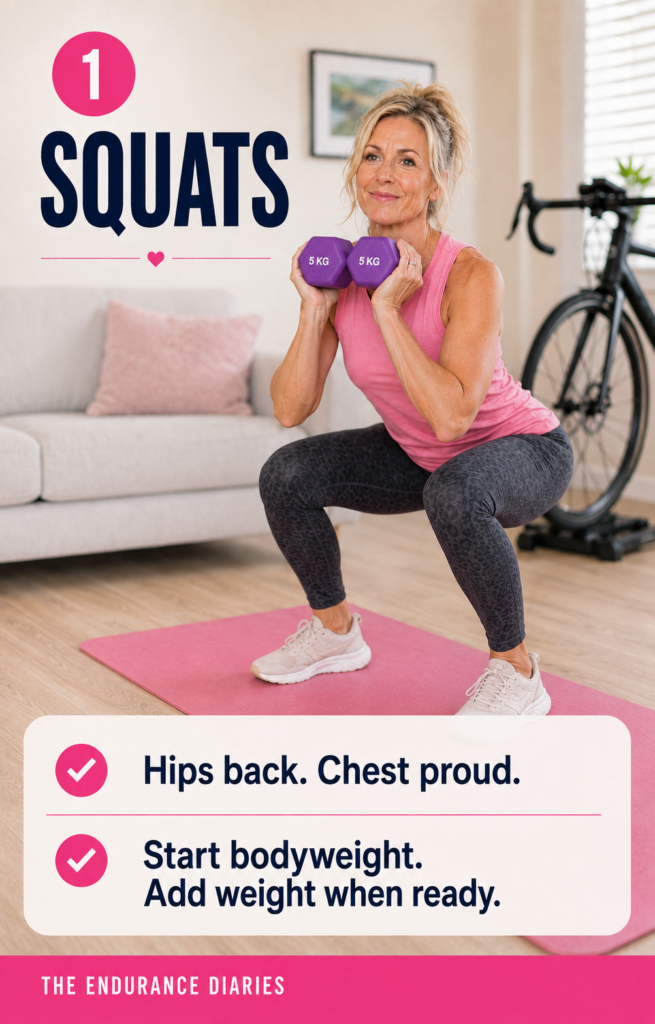
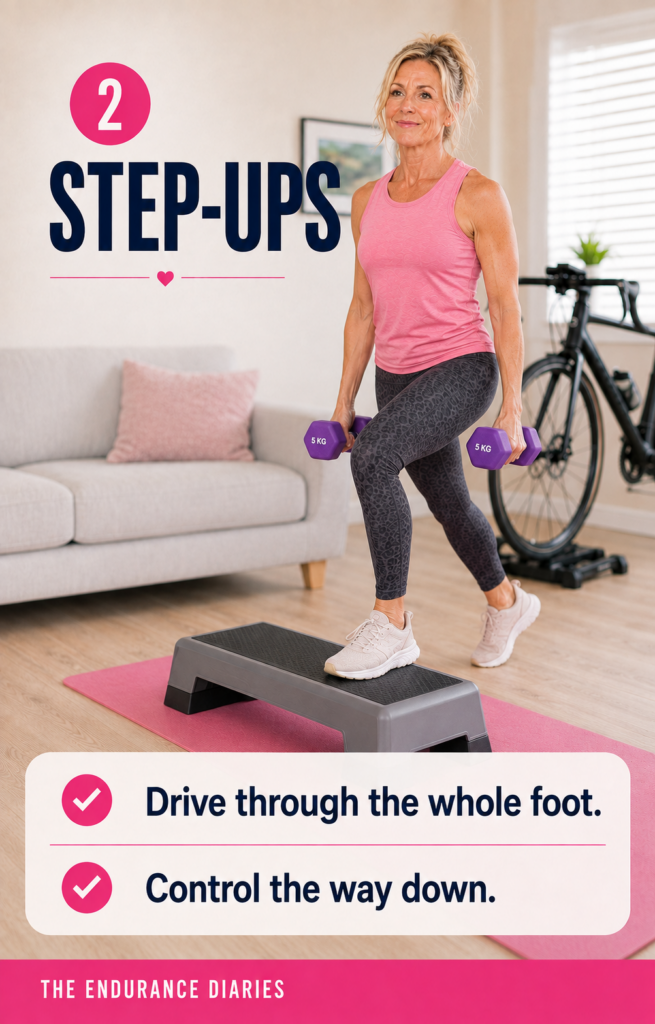
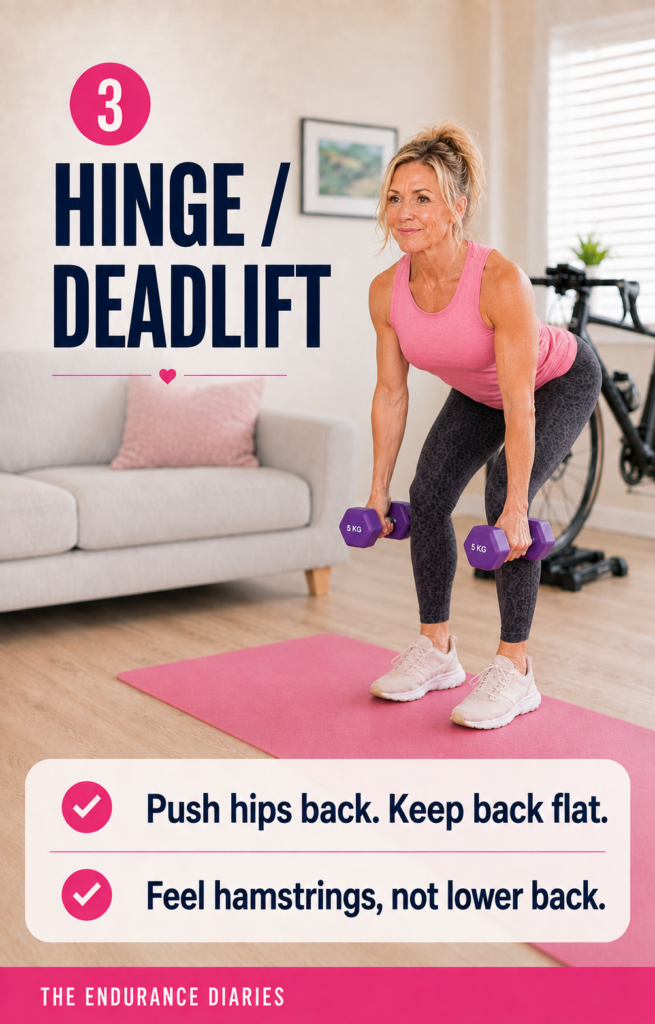
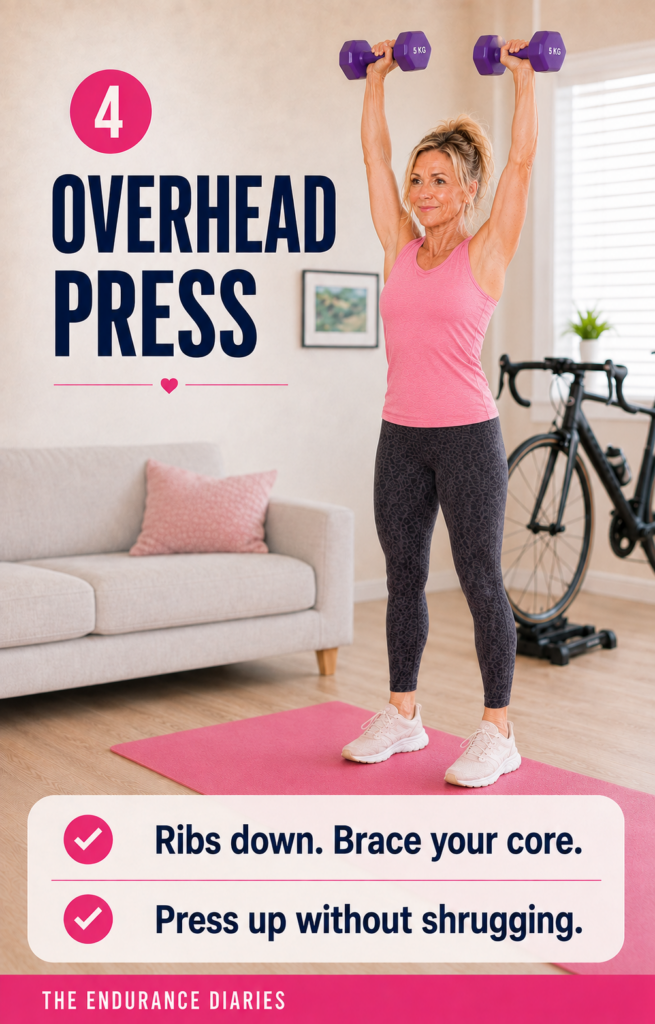
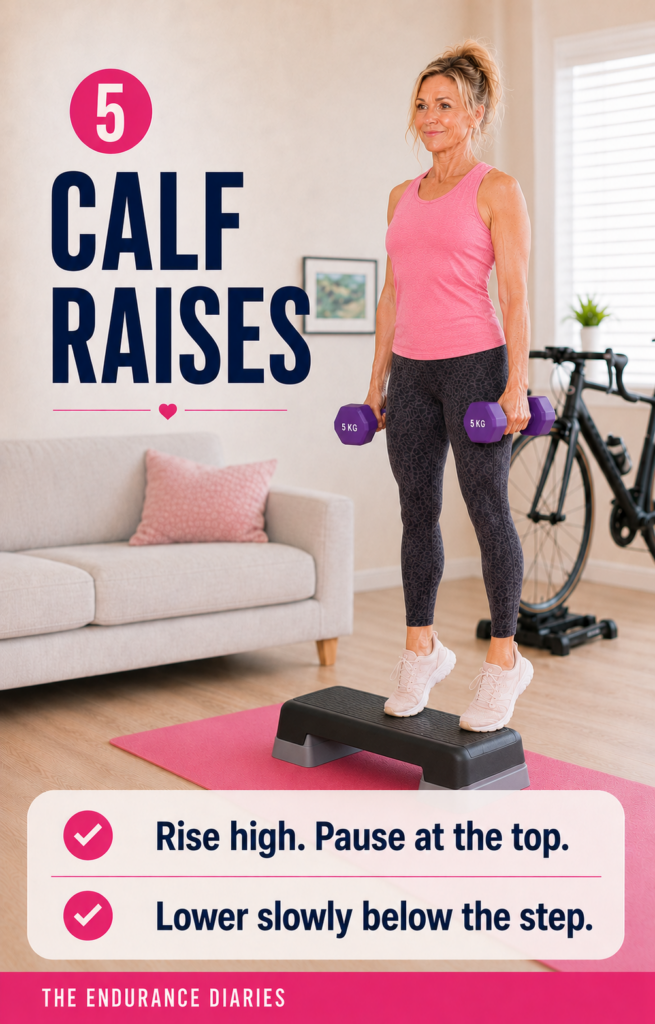
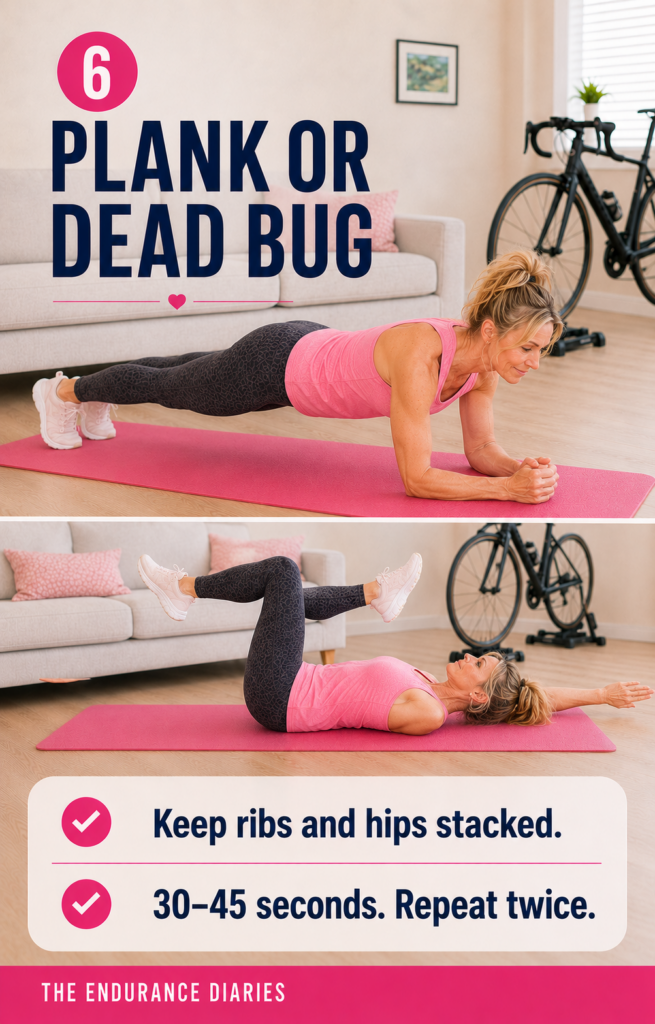
Two or three rounds. Rest as much as you need between them. Aim to finish feeling like you worked, not like you’ve been demolished — this shouldn’t cost you your Saturday ride.
If you’ve got an existing injury, or you’ve been told you have thin bones 🦴, get someone who knows what they’re looking at to check your form and your loading before you build a habit around it. A biokineticist or physio session or two is worth far more than another article on the internet — this one included. 🩷
Where to put it without wrecking your riding
The mistake I made the first time round was treating strength as an extra, bolted onto an already full week. Two weeks later, I was flat, blamed the strength work, and quit.
Strength is a hard day. Count it as one. If you’re already at your two or three hard sessions, something has to give — and the answer is almost always to drop one of the medium-hard rides that isn’t really doing anything for you anyway. We all have one. You know which one it is.
What’s worked for me:
- Strength on the same day as a hard ride, a few hours after — keeps the easy days genuinely easy
- Or strength on an easy day, with the ride kept short and gentle
- Never the day before a session that matters to you
- Two sessions, 48 hours apart, and stop fussing about which days
And give it twelve weeks before you judge it. Strength adaptations are slower than fitness adaptations, and the first month mostly feels like admin.
🩷 Keep track of what you’re actually doing
Two strength sessions a week sound easy until you look back at the month and realize you managed five in total. The Perimenopause Training Tracker logs strength alongside your rides, runs, sleep and energy — so you can see whether you’re actually doing the thing and what it’s doing for you.
The honest bit
I still don’t love it. I’ve been doing this consistently for a while now, and I have never once looked forward to a strength session the way I look forward to a ride.
What I do love is that my knees have stopped complaining on long rides. That I can get off the floor without making a noise. That the thing I was quietly worried about — slowly getting more fragile while technically being fit — has an actual answer, and the answer is twenty-five minutes twice a week in my lounge with two water bottles.
You don’t have to enjoy it. You just have to do it. 🩷
If you’re coming back from a break or an injury and wondering where strength fits into that, getting back on the bike after a break covers the rebuilding side, and this one is the honest version of what being injured actually feels like.
Being fit and being robust are not the same thing. I spent years working on the first one and assuming the second came free with it.

🩷The Endurance Diaries🩷