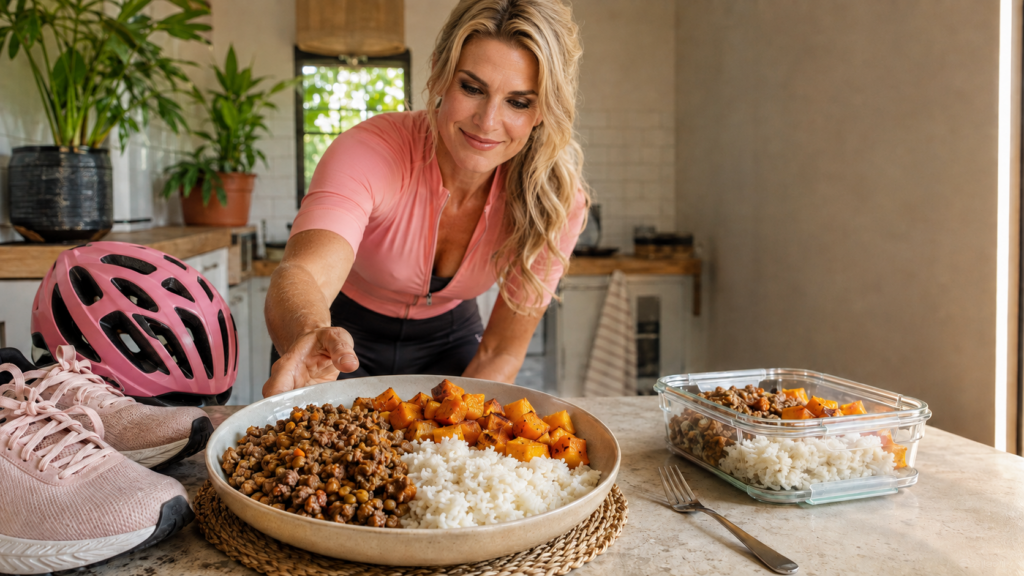
There is a very specific kind of hunger that arrives about forty minutes after a long ride. Not normal hunger. The kind where you stand in front of an open fridge in your cycling kit, slightly damp, staring at half a tub of leftover something and a lemon, making increasingly poor decisions.
I have eaten a lot of dry Provitas in that exact moment. I have also eaten an entire packet of biscuits standing up, which is a different article entirely.
The thing nobody tells you when you start training properly is that recovery food matters almost as much as the session did — and that it does not have to cost a fortune. You don’t need a R450 tub of imported protein powder or those little sachets that taste like sweet chalk. You need carbs, protein, fluid and salt. All of which are sitting in Checkers and Pick n Pay right now, for a fraction of what the supplement aisle wants from you.
So here are four honest, cheap, genuinely nice recovery meals I actually make. Real ingredients. Local brands. Nothing you have to order online or explain to your family. 🩷
What your body actually wants after a hard session 🍽️
Strip away the marketing and recovery eating comes down to four fairly boring things:
- Carbohydrates — to put back the fuel you just burned. Rice, pasta, potatoes, bread, oats, bananas. Yes, actual carbs. No, you don’t need to be scared of them.
- Protein — to repair the damage. Roughly a palm-sized portion, or about 20–30 g, is the usual guideline for most of us.
- Fluid — you’re almost always more dehydrated than you feel, especially after an indoor session.
- Salt — if your kit dried with white tide marks on it, you lost salt. Put some back.
That’s it. That’s the whole science section. Every recipe below hits all four without you having to think about it.
Quick honesty note: I’m a runner and a cyclist, not a dietitian. This is what works for me and for a lot of the women I train with. If you’ve got a medical condition, you’re pregnant, or you suspect something is genuinely off — go see a registered dietitian or your GP. Please don’t take nutrition advice exclusively from a woman on the internet, even a nice one. 🤗
The “30-minute window” — how much does it really matter? ⏱️
You’ve heard it. Eat within thirty minutes or your session was wasted. Cue mild panic while you fumble with a banana in the car park.
Here’s the more useful version: that window matters most when you’re training twice in a day, or riding hard again tomorrow morning. If you’re a normal human with a job, a family and one session a day, eating a proper meal within an hour or two is completely fine. Consistency across the week beats perfect timing on a Tuesday.
What actually derails recovery isn’t the clock. It’s having nothing in the house, being too tired to cook, and eating three rusks and calling it supper. Which is exactly the problem these four recipes are built to solve.
Recovery food doesn’t have to be impressive. It has to be eaten.
Recipe 1 · Five-Minute Peanut Butter & Banana Recovery Smoothie 🥤
This is the one for when you’ve just walked in the door and cooking is not happening. Carbs, protein, fluid and salt in one glass, made from things that live in your cupboard permanently. It’s also the only recipe here that a very tired person can make one-handed.
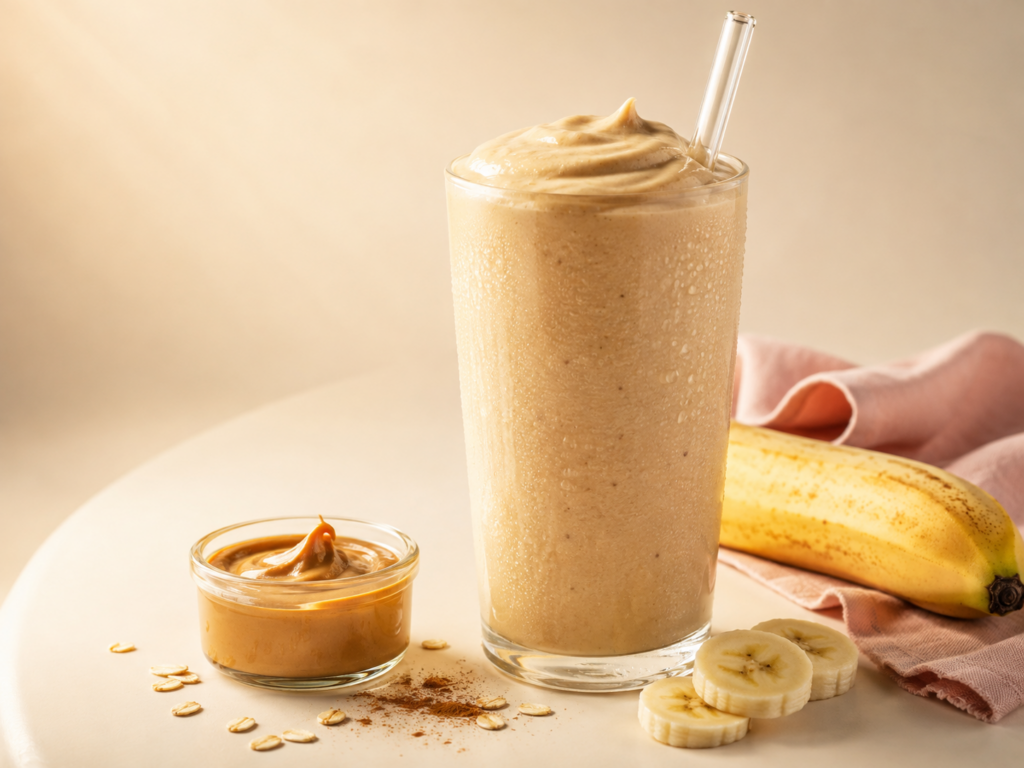
Serves 1 · 5 minutes · No cooking
🥤 Peanut Butter & Banana Recovery Smoothie
🛒 Ingredients
- 1 large banana — even better if you keep peeled, sliced bananas in the freezer
- 2 heaped tablespoons smooth peanut butter (Black Cat, Yum Yum, or the Checkers / PnP housebrand — honestly just as good)
- 250 ml milk — full cream if you’re deep in a training block, low fat if you prefer
- 2 tablespoons instant oats (Jungle Oats or Bokomo)
- 1 teaspoon honey — optional, but nice after a long one
- A proper pinch of salt (trust me)
- A handful of ice
👩🍳 Method
- Throw everything into a blender.
- Blend for about 45 seconds, until there are no oat lumps left.
- Drink it while you’re still in your kit. There is no step four.
🩷 Worth knowing: around 15 g protein as written. Want it closer to 25 g? Add two tablespoons of full cream milk powder (Nespray or Klim) — much cheaper per gram of protein than whey, and it makes the whole thing creamier.
🔄 Swaps: lactose intolerant — soy milk holds the protein best, oat milk tastes better but gives you less. No blender? Mash the banana properly, whisk everything in a jug, accept that it will be rustic.
Recipe 2 · Big-Batch Mince, Butternut & Rice Bowls 🍲
This is the workhorse. Make it once and portion it into five containers. Freeze the portions intended for later in the week rather than keeping the whole batch in the fridge until day four. Sources: Food Standards Scotland — Safe food storage; Food Standards Agency — Home food fact checker.
Small warning: beef mince has gone up a lot this year. The tin of lentils isn’t just a health thing — it stretches 500 g of mince across five decent portions instead of three.
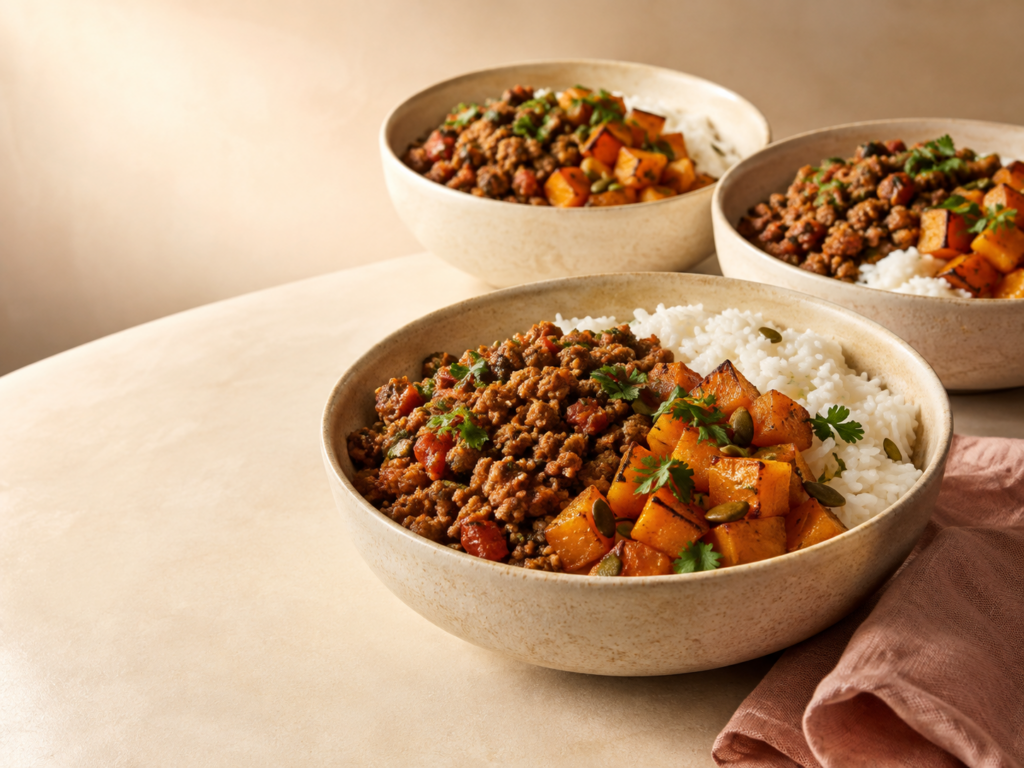
Makes 5 portions · 35 minutes · Freezer friendly
🍲 Mince, Butternut & Rice Bowls
🛒 Ingredients
- 500 g lean beef mince — or chicken mince, which is cheaper and works just as well here
- 1 large onion, chopped
- 2 teaspoons crushed garlic (the jar is fine, nobody is judging)
- 500 g frozen butternut chunks — the pre-cut bag saves you a fight with a knife
- 1 tin (400 g) chopped tomatoes
- 1 tin (400 g) brown lentils or sugar beans, drained and rinsed
- 2 tablespoons tomato paste
- 1 tablespoon Rajah Mild & Spicy curry powder, or 2 teaspoons Robertsons Barbecue Spice
- 1 beef or vegetable stock cube
- 2 cups uncooked Tastic rice — or brown rice if you have the patience
- A splash of sunflower oil, salt and black pepper
👩🍳 Method
- Get the rice on first, in a separate pot, according to the packet. It’ll be done before the rest.
- Heat the oil in a big pot and fry the onion for 3–4 minutes until soft. Add the garlic for the last 30 seconds.
- Add the mince. Break it up properly and brown it — don’t rush this bit, it’s where the flavour comes from.
- Stir in the curry powder and tomato paste. Cook for a minute so the spices wake up.
- Add the chopped tomatoes, the frozen butternut, the crumbled stock cube and about 150 ml water.
- Cover and simmer for 15–18 minutes, until the butternut squashes easily against the side of the pot.
- Stir in the drained lentils. Simmer uncovered for another 5 minutes to thicken. Season generously — you sweated out salt, remember.
- Portion the mince and rice into shallow containers and cool promptly. Refrigerate cooked rice within one hour and use within 24 hours, or freeze promptly for later meals. Thaw in the fridge and reheat until steaming hot throughout; reheat only once. Sources: Food Standards Scotland — Safe food storage; Food Standards Agency — Home food fact checker.
🩷 Worth knowing: this is the meal that saves Wednesday-you. Cook it on a Sunday, and you remove five separate decisions from your week.
🔄 Swaps: vegetarian — drop the mince, double the lentils and add a tin of chickpeas. Sweet potato works instead of butternut. A handful of baby spinach stirred in at the end disappears completely, and nobody has to know.
Recipe 3 · Fifteen-Minute Tomato Pilchard Pasta 🍝
Right. Stay with me on this one.
Tinned pilchards are one of the cheapest sources of protein in any South African supermarket, and they bring omega-3s along for the ride. Cooked like this — with onion, garlic and a squeeze of lemon — they stop tasting like a tin and start tasting like a proper puttanesca that cost you almost nothing.
If you genuinely cannot get past pilchards, tinned tuna works in exactly the same recipe. But try it once.
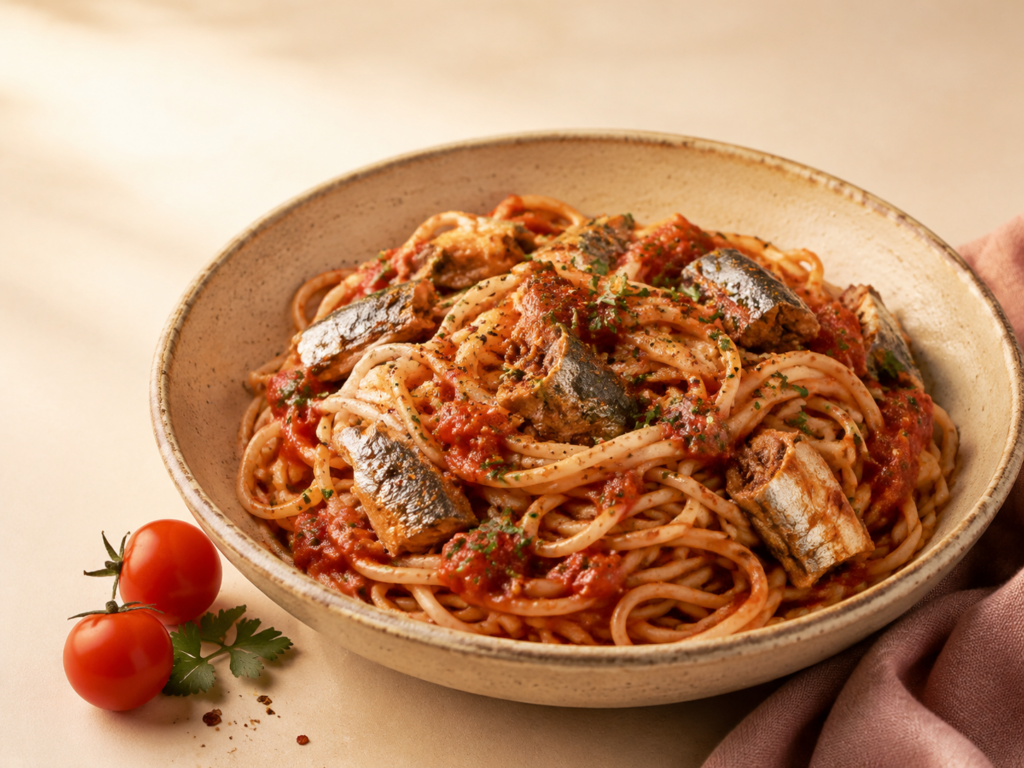
Serves 3 · 15 minutes · One pan
🍝 Tomato Pilchard Pasta
🛒 Ingredients
- 300 g pasta — macaroni, penne or spaghetti, whatever’s on promotion
- 1 tin (400 g) Lucky Star pilchards in tomato sauce, or 2 tins shredded tuna in brine
- 1 onion, finely chopped
- 2 teaspoons crushed garlic
- 1 tin (410 g) whole kernel corn, drained
- 1 tablespoon tomato paste
- 1 teaspoon Robertsons Mixed Herbs, or a shake of Aromat
- A squeeze of lemon juice and plenty of black pepper
- A splash of oil
👩🍳 Method
- Boil the pasta in well-salted water. Before you drain it, scoop out a mug of the cooking water and keep it.
- While the pasta cooks, fry the onion in oil for 4 minutes until soft and just starting to catch. Add the garlic for the last 30 seconds.
- Stir in the tomato paste and herbs and cook for a minute.
- Tip in the whole tin of pilchards, sauce and all. Break the fish up gently with a wooden spoon — you want flakes, not paste.
- Add the drained corn and let it all bubble for 3–4 minutes.
- Add the drained pasta plus a good splash of that reserved pasta water. Toss until the sauce coats everything and looks glossy rather than dry.
- Finish with lemon juice and black pepper. Eat immediately.
🩷 Worth knowing: don’t skip the pasta water. It’s what turns “fish and pasta in the same bowl” into an actual sauce.
🔄 Swaps: vegetarian — swap the fish for a tin of chickpeas and a handful of grated cheddar stirred in at the end. Big training day tomorrow? Add a second tin of corn and use 400 g pasta.
🍽️ Like this, but for a whole month?
Four recipes will get you through a week. The 30-Day Endurance Fuel Meal Plan gets you through a training block — breakfast, lunch, dinner and a snack for every single day, tagged by rest day, training day and long session day. It comes with hydration targets, a race-week fuelling section, and two grocery lists with quantities, covering Weeks 1 & 2 and Weeks 3 & 4, all built around ingredients you can actually find at Checkers, Pick n Pay, Shoprite or Woolies.
No fads. No guilt. No obscure superfoods. Just a month of not standing in front of the fridge wondering what to eat.
Recipe 4 · Peri-Peri Chicken Livers on Toast 🍞
Here’s something that doesn’t get said often enough: a lot of women in endurance sport are quietly running on low iron. It shows up as heavy legs, a heart rate that won’t settle, and that flat feeling where the session should be easy but isn’t.
Chicken livers are one of the cheapest, most iron-dense things in the entire shop. A tub costs less than a single energy bar. And made like this, with peri-peri and a bit of cream, they’re a proper Friday-night-restaurant starter that you’re eating at 7pm in your socks.
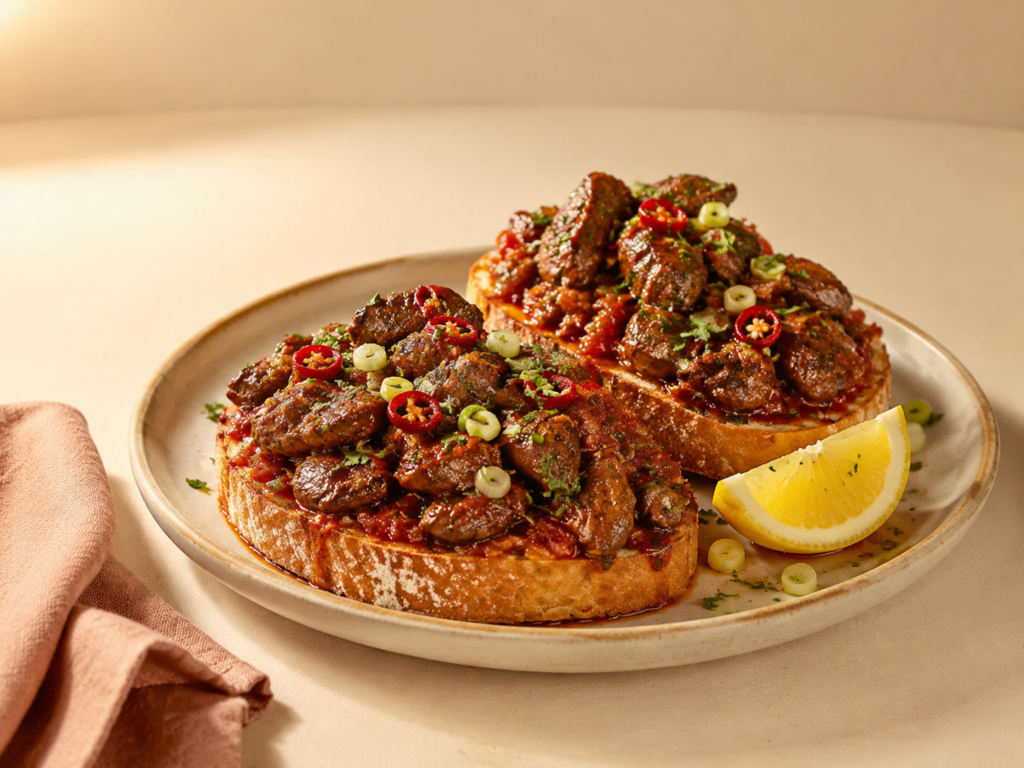
Serves 2 · 20 minutes · Iron-rich
🍞 Peri-Peri Chicken Livers on Toast
🛒 Ingredients
- 500 g chicken livers, rinsed and trimmed of any stringy bits
- 1 onion, finely chopped
- 2 teaspoons crushed garlic
- 1 teaspoon peri-peri spice or Robertsons Chilli Spice — start low, you can always add
- 1 teaspoon paprika
- 3 tablespoons All Gold tomato sauce, or 2 tablespoons tomato paste plus a pinch of sugar
- 1 teaspoon Worcestershire sauce
- 60 ml cream, or plain double cream yoghurt if you’d rather
- 4 thick slices of brown or low-GI bread, toasted
- Oil, salt and black pepper
- To serve, optional: sliced fresh chilli, spring onion and a lemon wedge
👩🍳 Method
- Pat the livers dry with paper towel. This is the difference between livers that fry and livers that steam.
- Heat oil in a pan until properly hot. Fry the onion for 3 minutes, then add the garlic, peri-peri and paprika for 30 seconds.
- Add the livers in one layer and turn them as they cook. Use a digital probe thermometer to check the centres of the thickest pieces: they must reach 70°C and stay at or above that temperature for at least two minutes. Keep cooking until this temperature and holding time are met; colour alone is not a reliable safety check. See Food Standards Australia New Zealand’s poultry liver guidance.
- Stir in the tomato sauce, Worcestershire sauce and a splash of water. Let it bubble for 2 minutes.
- Turn the heat right down, stir in the cream, and warm through without boiling. Season well.
- Spoon over hot toast. Eat with a knife and fork and absolutely no dignity.
🩷 Worth knowing: the toast isn’t optional — it’s the carb half of the meal. And if you genuinely suspect your iron is low, please don’t self-diagnose from a blog post. Go get bloods done. Livers are lovely, but they’re not a substitute for knowing your actual numbers.
🔄 Swaps: not a liver person — the exact same sauce is excellent over 400 g sliced mushrooms plus a tin of lentils. Different meal, same comfort.
Making this actually happen in a real week 🛒
Recipes are easy. Doing them on a Wednesday after work is the hard part. Three things that genuinely help:
- Cook once, portion for five meals. Refrigerate only the portions you will eat within the safe storage period and freeze the rest promptly. Plan ahead to thaw a frozen portion in the fridge. Sources: Food Standards Scotland — Safe food storage; Food Standards Agency — Home food fact checker.
- Keep a recovery shelf. One shelf, one job: peanut butter, oats, tinned fish, tinned corn, tinned lentils, pasta, rice, long-life milk. If those are there, you’re never more than fifteen minutes from a real meal.
- Freeze in single portions. A full container of leftovers is a project. One portion is dinner.
Total shopping list for all four recipes, give or take what you already have: mince, chicken livers, a tin of pilchards, bananas, peanut butter, milk, oats, rice, pasta, frozen butternut, two tins of tomatoes, a tin of lentils, a tin of corn, onions, garlic, bread and your usual spices. That’s one basket, and it feeds you properly for most of a week. Prices move constantly, so I’ve deliberately not quoted rands — but every single item above sits in the everyday-staples half of the shop, not the sports nutrition aisle.
The honest bit 🩷
You don’t need expensive food to train well. You need enough food, often enough, with a bit of protein in it. That’s the whole secret, and it costs about the same as what you’re already spending — it’s just arranged differently.
Some weeks I do all of this properly and feel like a functioning adult. Other weeks I eat toast at nine o’clock and go to bed. Both weeks still count. The goal was never perfect fuelling — it was having something decent in the house on the days when you’ve given everything you had to the session, and there’s nothing left for the kitchen.
Fuelling well isn’t a budget problem. It’s a planning problem — and that one you can actually solve on a Sunday afternoon.
Made one of these? Changed it and made it better? I’d love to hear about it — pop me a message through the contact page. And if you’ve got a cheap recovery meal that’s carried you through a training block, send it my way. I’m always collecting. 🩷

🩷The Endurance Diaries🩷