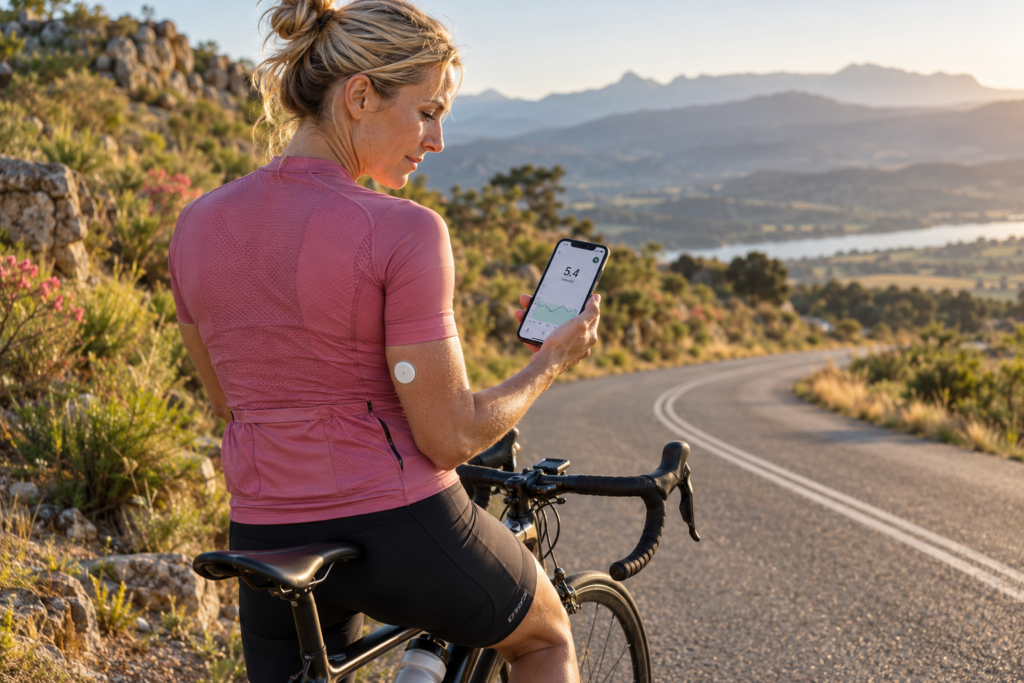
An app that says “Eat now, before you bonk” sounds useful. No guesswork, no forgotten gel, no final-hour implosion. It is easy to see the appeal of a continuous glucose monitor, or CGM, for cyclists.
The catch is that glucose readings are not a direct measure of your remaining fuel. A CGM can add information, but it cannot reliably tell a rider without diabetes exactly when and how much to eat.
⚠️ This article is for riders without diabetes. If you have diabetes, use the exercise and glucose-management plan agreed with your healthcare team. Unexpected readings or symptoms warrant appropriate medical advice, regardless of your fitness level.
What the sensor can actually see
A CGM measures glucose in fluid between cells under the skin. It does not directly sample blood, measure muscle glycogen, or show the rate at which you are burning carbohydrate. Readings can also lag behind blood glucose when levels are changing quickly.
A 2025 review in Performance Nutrition explains why those limitations undermine the idea of a real-time fuel gauge. It also found insufficient causal evidence that keeping glucose within a particular non-hypoglycaemic range, or keeping the graph flatter, improves performance.
A rising line does not automatically mean too much fuel
During intense exercise, glucose can rise as the liver releases it into circulation. A race-day increase is therefore not, by itself, a reason to stop taking carbohydrates. Similarly, a lower sensor reading does not tell you how much muscle glycogen remains.
The Sports Medicine discussion by Flockhart and Larsen highlights that athletes’ glucose responses require context and that there are no agreed-upon methods for using CGMs to improve performance. A single trace cannot tell you whether your breakfast was “good”, your training was excessive or your muscles were empty.
Fuel the session you planned. Do not skip a gel simply to make a glucose graph look tidier.
What to do with an unexpected reading
Consider the trend, sensor limitations, recent food, exercise and how you feel. Accuracy varies with the device and conditions; exercise can make interpretation harder. There is no established universal “ideal athlete range”, and that does not make every unusual reading harmless.
Repeated unexplained highs or lows should be discussed with a healthcare professional. If you feel shaky, dizzy or unusually weak, stop safely and assess the situation. Do not dismiss symptoms because the app looks normal. NHS guidance advises medical assessment for symptoms of low blood glucose in people without diabetes.
If low blood glucose is suspected and you are alert and able to swallow, take a fast-acting source of carbohydrate, such as glucose tablets or juice. Get urgent help if symptoms are severe or do not improve. Do not give food or drink to someone who is unconscious or unable to swallow safely.
A more useful fuelling plan
Base the plan on ride length, intensity, what you ate beforehand and gut tolerance. Australian Institute of Sport guidance gives these practical starting points:
- About 1–2.5 hours: 30–60 g carbohydrate per hour for endurance exercise.
- Beyond roughly 2.5–3 hours: up to 90 g per hour may be useful, especially for demanding sessions. Build tolerance in training; higher intakes usually use glucose–fructose combinations.
- Short sessions: an easy ride after a meal may need little extra carbohydrate. A hard effort of around an hour can still benefit from small amounts.
For example, a bottle containing 30 g carbohydrate plus a 25 g gel provides 55 g in that hour. Read the labels, count all sources, and spread intake into manageable portions. Plan fluids separately around the conditions and your needs; do not base extra drinks on reaching a carbohydrate total.
🚴♀️ The basics right before the gadgets
A CGM is a fun extra, but it can’t replace a solid indoor setup and simple fuelling habits. The Indoor Cycling Starter Pack helps you set up your space, kit, and routine so every ride starts right.
Use a diary before chasing another metric
Record what you ate, when you ate it, the session’s duration, late-ride power or pace, gut comfort and recovery. If you already use a CGM, its trace can sit alongside that information as context rather than deciding every food choice.
A timer reminding you to eat regularly may solve the practical problem more simply than another sensor. Pack the fuel, practice the plan, and adjust it from repeated practice. You do not need a perfect glucose graph to fuel a good ride. 🩷

🩷The Endurance Diaries🩷