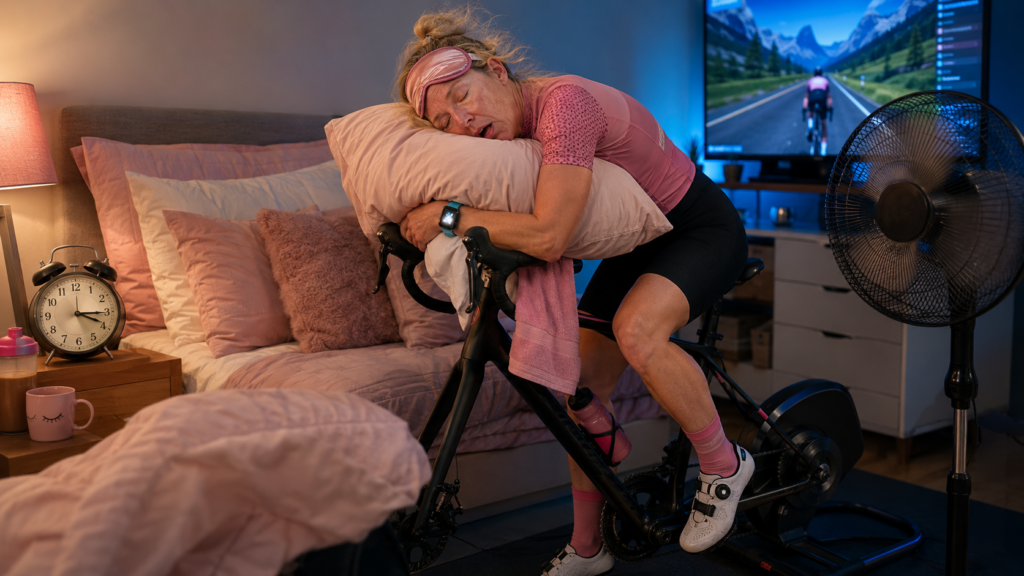
There is a particular kind of tired that has nothing to do with your legs. You know the one. You get on the bike, the numbers look normal, the resistance is what it always is — and yet twenty minutes in you are already negotiating with yourself about whether this really needs to be a full session.
Poor sleep is one possible reason a familiar session feels harder. It is not the only one. Sources: Kong et al. (2025), systematic review.
We plan everything else. Kilometres, intervals, rest days, what we eat before a long run, which kit is clean. And then there is this eight-hour block every single night that we treat as the leftover space — the bit that gets squeezed when work runs late, when someone needs something, when the day simply refuses to end. So let’s ask the honest question: what is the actual minimum a runner or cyclist can get away with?
So what is the actual minimum?
The frustrating answer is that there is no single number that works for everybody. Sleep need is genuinely individual — some people are fine on seven, some people are wrecked on anything under eight, and both of those are normal.
But the sleep specialists who work with athletes are fairly consistent about the range, and it looks like this:
😴
Allow enough sleep Sources: CDC — About Sleep.
Adult sleep needs vary with age: CDC recommends at least 7 hours for ages 18–60, 7–9 for ages 61–64, and 7–8 for ages 65 and older. Sources: CDC — About Sleep.
🚩
Six hours is not a safe floor Sources: CDC — About Sleep.
Six hours is not a safe minimum or a training target. Most adults need at least seven hours, and individual needs vary. Sources: CDC — About Sleep.
🏋️♀️
Allow for individual needs Sources: Walsh et al., athlete sleep consensus.
Training schedules and recovery needs matter. There is no fixed sleep duration that fits every athlete or every hard week. Sources: Walsh et al., athlete sleep consensus.
Allow enough time for your individual sleep needs, generally at least seven hours for adults. Persistent fatigue or disrupted sleep warrants attention even if you meet that number. Sources: CDC — About Sleep.
Feeling functional is not the same as being rested Sources: CDC — About Sleep.
Here is the trap. Six hours does not feel like a crisis. You get up, you get the coffee in, you get through the day. You are functional. And because you are functional, you assume you are fine.
Persistent short sleep and daytime tiredness deserve attention. This article does not establish a precise six-and-a-half-hour injury threshold. Sources: CDC — About Sleep.
If you are hovering at six hours and you are tired during the day, struggling to bounce back between sessions, or watching your training quietly deteriorate — that is not you being soft. That is the data.
What short sleep actually does to your training
A 2025 systematic review and meta-analysis in Frontiers in Physiology pulled together 45 studies on sleep deprivation and performance — 16 of them specifically on aerobic endurance, and 12 on rate of perceived exertion. The findings are not subtle.
Effort can feel harder. The review found increased perceived exertion overall; responses differ between people and sleep-loss conditions. Sources: Kong et al. (2025), systematic review.
Aerobic endurance drops. Not just the feeling of it — the measured output. The same review found meaningful impairment in endurance performance, alongside reductions in explosive power, maximum force, speed and skill control.
Sleep loss can affect skill as well as physical performance. The review does not establish that coordination always deteriorates before power. Sources: Kong et al. (2025), systematic review.
Protect sleep as part of recovery. A short night does not prove that the benefits of your training have been erased. Sources: Walsh et al., athlete sleep consensus.
One rough night will not undo you. We are human, life happens, babies and deadlines and 2am anxiety spirals all exist. But if you wake up genuinely wrecked on an interval day, the smart move is to swap it for something easy and come back to the hard session when you are actually able to do it justice.
The part nobody mentions if you’re over 40
Most sleep-and-performance advice is written as though everyone reading it has a stable, cooperative hormonal system. Many of us do not.
In a cross-sectional SWAN community survey of 12,603 women aged 40–55, 38% reported difficulty sleeping in the previous two weeks. Menopausal stage was associated with sleep difficulty, alongside other health, symptom and lifestyle factors. The survey did not establish the cause of any individual woman’s sleep problems.
If you are waking at 3am despite trying to sleep well, hormonal changes may be one contributor, but other causes should also be considered. Persistent or disruptive sleep problems deserve assessment rather than an automatic hormonal explanation. Sources: Kravitz et al. (2003), SWAN survey.
What that changes practically: be more generous with your time in bed, because your time asleep will be lower than your time in bed. Be more willing to shift a hard session after a broken night. And if the disruption is severe or persistent, it is worth raising with your doctor rather than filing it under “this is just my life now” — there are real options, and this is a medical conversation, not a motivational one.
The 8pm Zwift problem
This one is going to sting a bit, because it is most of us.
A 2025 study published in Nature Communications tracked 14,689 physically active people over a full year — more than four million nights of data — and looked at how the timing and intensity of evening exercise affected the sleep that followed.
The study linked later, higher-strain exercise with poorer subsequent sleep and altered overnight heart-rate measures. These are observational associations, not proof that exercise caused a particular person’s poor sleep. Sources: Leota et al. (2025), evening exercise and sleep.
The findings support moving demanding sessions earlier where practical. They do not establish a guaranteed safe bedtime buffer for every person. Sources: Leota et al. (2025), evening exercise and sleep.
Which is awkward, because an 8pm race on Zwift with a bedtime of 10pm is one of the most normal things in our world. So what do you actually do?
- When practical, move hard evening exercise earlier. The study described above found an association within four hours of sleep onset; it does not establish a universally safe two-hour buffer. If you must train late, consider an easier session and monitor your sleep. Sources: Leota et al. (2025), evening exercise and sleep.
- Match the session to the slot. If the only window is late, that is your easy endurance slot. Save the intervals and the races for a morning or weekend slot where you have the buffer.
- Actually wind down afterwards. Stretch, foam roll, slow breathing. Do not go straight from a sprint finish to lying in the dark wondering why your heart is still going.
- Cool the room and cool yourself. A warm shower followed by a cool-down period helps. Sitting in a hot lounge in your sweaty kit does not.
- Get the screens down. Finishing a race and then scrolling the results, then Instagram, then WhatsApp, is a full extra hour of blue light and stimulation on top of the session.
🚴♀️ Building a smarter indoor setup?
Half the reason evening sessions run late is a setup that fights you — the fan you have to fetch, the laptop you have to reconnect, the twenty minutes of faffing before you even clip in. The Endurance Diaries shop has practical training tools and trackers built for women who train around full lives, not around perfect ones.
Hours are only a third of the story
Sleep specialists tend to assess three things, not one: duration, timing and quality. Chasing the hours while ignoring the other two is why some people log eight hours and still feel like they have been hit by a bus.
Duration
Use the age-based guidance above as a starting point and allow for your own needs. Time in bed is not the same as time asleep. Sources: CDC — About Sleep.
Timing
Keep bedtimes and wake times consistent while leaving enough time to sleep. A fixed wake time should not become a reason to accept chronically short sleep. Sources: CDC — About Sleep; NIH NHLBI — Healthy sleep habits.
Consistency is one useful part of a sleep routine; duration and quality matter too. Sources: CDC — About Sleep.
Quality
If you remain exhausted despite allowing enough sleep, discuss possible causes with your healthcare provider. Do not assume that either more time in bed or a better routine will solve every sleep problem. Sources: CDC — About Sleep.
Use sleep-device trends as background information, not a diagnosis or permission to ignore symptoms. Consider how you feel and seek advice for persistent problems. Sources: Walsh et al., athlete sleep consensus.
Race week: build yourself a buffer
Race-eve sleep can be disrupted. One poor night does not guarantee a bad race, but it also does not guarantee that performance will be unaffected. Sources: Walsh et al., athlete sleep consensus.
Protect adequate sleep in the lead-up to a race. Extra sleep may help some athletes, but it cannot guarantee that a disrupted night will have no effect. Sources: Walsh et al., athlete sleep consensus; NIH NHLBI — Healthy sleep habits.
After a hard race, allow enough sleep and adjust recovery to how you feel. There is no universal three-day sleep prescription here. Sources: Walsh et al., athlete sleep consensus.
Naps may help some athletes, but the best timing and duration vary. They should not replace adequate night-time sleep. Persistent daytime sleepiness despite enough sleep opportunity deserves assessment. Sources: Walsh et al., athlete sleep consensus; CDC — About Sleep; NIH NHLBI — Healthy sleep habits.
The honest bottom line
Most adults need at least seven hours, with individual variation. Six hours is not a safe fallback target. Keep a consistent sleep schedule, consider moving hard evening sessions earlier, and seek help for persistent sleep difficulties. Sources: CDC — About Sleep; Leota et al. (2025), evening exercise and sleep.
Sleep belongs in the training plan. Protect it alongside the sessions rather than treating it as leftover time. Sources: Walsh et al., athlete sleep consensus; NIH NHLBI — Healthy sleep habits.
And no — I am not going to pretend I have this perfectly sorted. I have sat on the trainer at half past eight on a Tuesday knowing full well I would be in bed by ten. Some weeks that is simply the only slot that exists. The point is not perfection. The point is knowing what it costs, so you can choose it deliberately instead of wondering why everything feels so hard.
Sleep isn’t the reward for a good training week. It’s the part of the training week that makes the rest of it count.
How much sleep are you actually getting in a normal week — and be honest, not aspirational? I would love to hear how you make it work around real life. Drop me a line at liz@theendurancediaries.co.za. 🩷
This article is general information for healthy adults, not medical advice. Persistent insomnia, snoring, pauses in breathing during sleep, or exhaustion that does not improve with more rest are all worth discussing with your doctor.

🩷The Endurance Diaries🩷