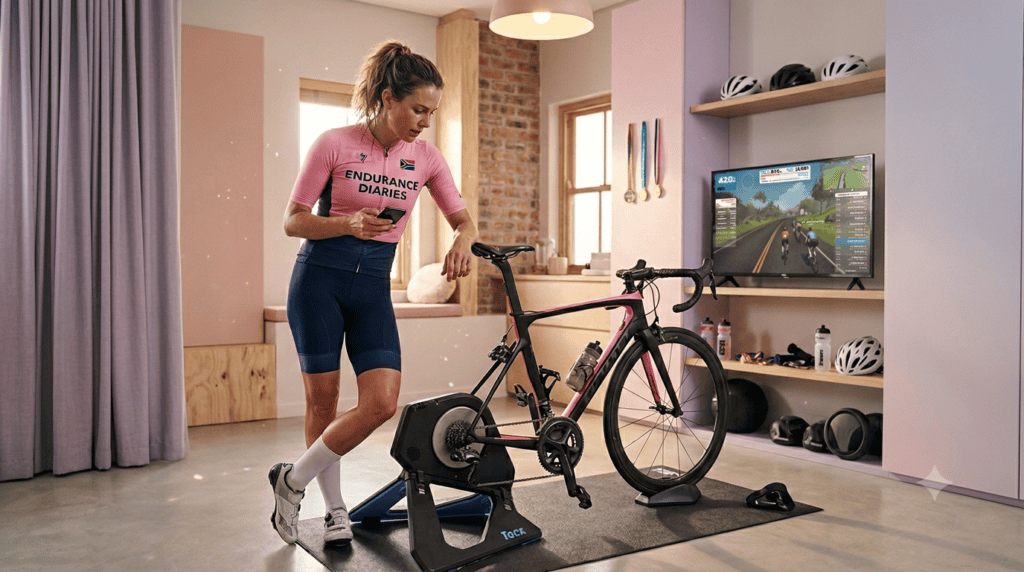
A smart trainer is the piece of kit that turns your normal bike into an indoor training machine — and it’s what makes apps like Zwift come alive. But it’s also usually the biggest spend when you’re getting started indoors, so it’s worth getting the choice right.
Here’s a plain-English guide to choosing your first one in South Africa — no jargon, no pressure to buy the most expensive thing on the shelf. 🩷
What a smart trainer actually does
A smart trainer connects to your training app over Bluetooth or ANT+, measures how hard you’re pedalling, and automatically changes the resistance to match the ride on screen. The road goes up; pedalling gets harder; the road flattens; it eases off. That two-way connection is what makes indoor riding feel real — and it’s the difference between a “smart” trainer and a basic “classic” one.
The two main types
Wheel-on (your back wheel stays on)
A roller presses against your back tyre. These are usually cheaper and lighter, which makes them a great entry point. The trade-offs: they can be a bit noisier, they wear your tyre (a cheap “trainer tyre” fixes this), and the road feel is slightly less realistic. For a beginner on a budget, they’re completely fine.
Direct-drive (your back wheel comes off)
You take the back wheel off and attach the bike straight onto the trainer’s cassette. These are quieter, more accurate, and feel the most like riding outside — but they cost more. If indoor riding becomes a big part of your training, this is the upgrade you’ll eventually want.
Do you even need a smart one to start?
Honestly? Not necessarily. A basic classic trainer plus a cheap speed sensor will still get you onto Zwift — you just change the “gears” manually instead of the trainer doing it for you. If money’s tight, that’s a perfectly good way to begin, ride for a season, and see if you love it before spending more. There’s no shame in starting small. Consistency matters far more than kit.
What to look for when you buy
- Bike compatibility. Check it fits your bike’s axle type (quick-release or thru-axle) and, for direct-drive, that the cassette matches your groupset.
- App connectivity. You want Bluetooth and/or ANT+ so it talks to Zwift and your other devices.
- Noise. If you train early or share walls, a quieter direct-drive is worth it. Wheel-on trainers are louder.
- Accuracy. Trainers list a power-accuracy figure (e.g., ±2–3%). Closer to zero is better, but beginners don’t need to obsess over this.
- Warranty & local support. Buying a brand with local SA support makes life much easier if something goes wrong.
You’ll come across brands like Zwift, Wahoo, Elite, Tacx (Garmin), Saris and JetBlack — all make trainers at different price points. Rather than chasing a specific “best” model (they change every year), match the type and features above to your budget and your bike.
Where to buy in South Africa
- Your local bike shop. Great for advice, fitting help and after-sales support — and you’re supporting local.
- Online SA cycling retailers. Often better prices and easy to compare. Check the warranty and return policy.
- Second-hand. The indoor-training world upgrades often, so good used trainers regularly come up in marketplace groups. Just test it connects to an app before you pay.
Prices move with the rand and with new models landing, so always check current pricing at a couple of SA retailers before you commit.
Got your trainer? Now stay consistent 🩷
The trainer is the easy part — showing up is the hard part. My Training Tracker helps you plan your rides and tick them off week by week, so all that kit actually gets used. Instant download.
My honest beginner recommendation
If you can stretch to a direct-drive smart trainer from a brand with local support, you’ll never regret it — it’s quiet, accurate, and will last for years. But if that’s not the budget right now, start with a wheel-on smart trainer, or even a classic trainer and a speed sensor. Get riding, build the habit, and upgrade later once you know indoor training is your thing. The best trainer is the one that gets you pedalling this week. Then follow a simple 4-week plan, and you’re away.
The best trainer is the one that gets you pedalling this week — not the one with the best spec sheet.

🩷The Endurance Diaries🩷