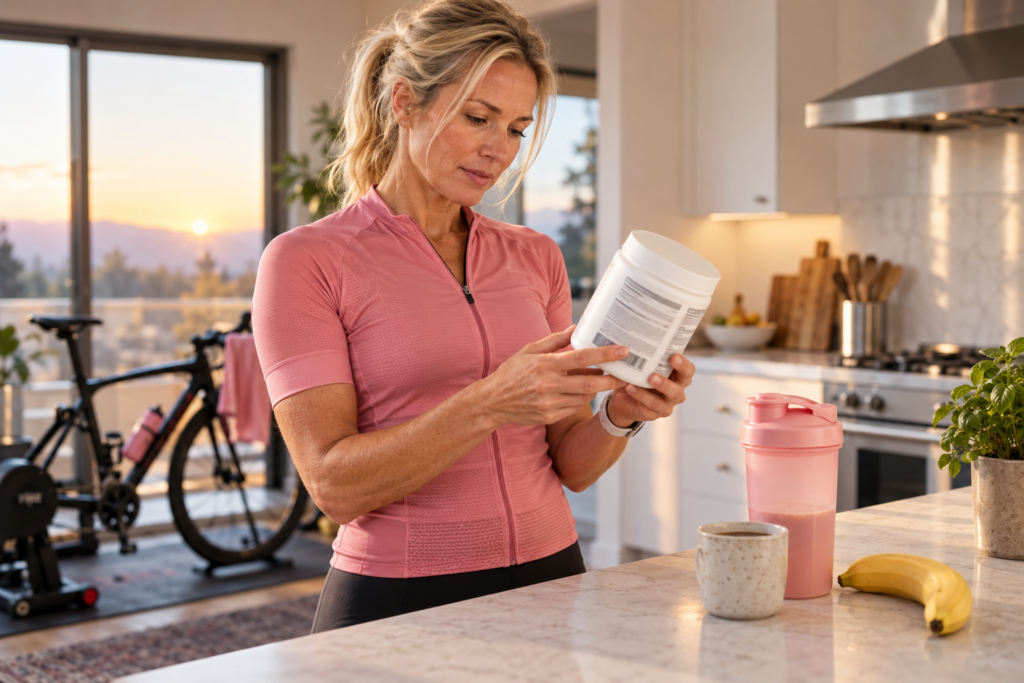
Confession time: I have absolutely been the woman standing in the kitchen at 4:50am, half-asleep, shaking a scoop of something neon into a bottle because a Zwift race starts in ten minutes. 😅 I didn’t read the label. I just trusted the tub.
This month’s news is a good reason to slow down. A US pre-workout powder has been recalled after FDA testing found DMAA, a stimulant that wasn’t declared on the label. That last part is the real lesson: some risks don’t show up on the label at all.
So here’s what happened, what to do if you own the product, and the practical checks that actually lower your risk. 🩷
The DMAA Recall: What Happened
On 6 October 2026, US company Leader Formulas, LLC announced a voluntary nationwide recall of RAPTURE Preworkout after FDA testing found it contained DMAA (1,3-dimethylamylamine). The FDA published the notice on 7 October. You can read the official recall notice on the FDA website.
- Lot number: 260327-4 (only this lot is recalled)
- Container: 450 g round plastic tub with red and black lettering and a rhinoceros-print seal on top
- Flavors: Rainbow Twist, Electric Lemonade, and Berry Mojito
- Where it was sold: distributed across the US to retail stores and through the company’s website, between 29 January 2025 and 25 May 2026
- Reported reactions: at the time of the recall, the company said it had received no adverse event reports
According to the notice, DMAA can raise blood pressure and could lead to cardiovascular problems, including heart attack, shortness of breath, and chest tightness.
If you have this product
- Stop using it and check the lot number on the tub.
- Return it to where you bought it for a full refund, as the recall notice instructs.
- Questions? The company lists Patrick@leaderformulas.com and +1 832-855-7562 (Monday to Friday, 9am–5pm US Central Time, which is roughly 4pm–12am in South Africa).
🚨 Feeling unwell after taking a pre-workout? Chest pain or tightness, shortness of breath, a racing or irregular heartbeat, fainting, or a seizure need emergency care straight away. For other side effects, see your doctor promptly and take the tub with you.
Does this affect South Africans? The recall notice only describes distribution in the US, so we don’t know whether any of this lot reached South Africa through online orders or imports. If you’ve bought pre-workouts from overseas sites, it’s worth checking your cupboard.
What a Label Can and Can’t Tell You
Reading the label is a useful first check, but it can’t reveal an undeclared stimulant. This isn’t just a US problem either. The South African Institute for Drug-Free Sport (SAIDS) has warned athletes about a pre-workout whose samples contained a stimulant not listed on the label, and noted that supplement manufacturing isn’t regulated in South Africa.
Checking recall notices and independent certification helps reduce the risk too. Think of it as three layers: the label, the recall lists, and third-party testing. None of them is perfect on its own.
Names DMAA may appear under
When DMAA is listed, it may appear under other names. If you spot any of these on an ingredient list, don’t use the product:
- 1,3-dimethylamylamine or 1,3-DMAA
- Dimethylamylamine
- Methylhexanamine (also spelled methylhexaneamine)
- Geranamine
A note on “geranium”: DMAA has been marketed as derived from geranium, so some products list it as geranium extract, geranium oil, or Pelargonium graveolens. That doesn’t mean every genuine geranium ingredient contains DMAA. But if you see a geranium ingredient in a stimulant-style pre-workout, check whether the product is third-party certified, or ask a pharmacist or registered dietitian before using it.
Why “proprietary blends” are a problem
Many pre-workouts list an “energy matrix” or “proprietary blend” with one total weight and no individual amounts. That makes it hard to know how much caffeine or other stimulants you’re actually taking.
What to look for instead:
- Clearly named ingredients with disclosed amounts
- Caffeine stated in mg per serving
- A batch or lot number on the container
- Caution with products that combine several stimulants
Caffeine: Guidance, Not a Target
Even a fully legal pre-workout can carry a big caffeine hit. For context, the European Food Safety Authority (EFSA) concluded that, for healthy adults, single doses of up to about 200 mg and daily intakes of up to about 400 mg generally do not raise safety concerns. For pregnancy and breastfeeding, EFSA’s level is up to 200 mg a day.
These aren’t doses to aim for, and they’re not a guarantee. People respond very differently to caffeine, and some health conditions and medications change that picture completely. Remember that caffeine stacks up: coffee, gels, energy drinks, cola, and pre-workout all count towards your total.
If you race on Zwift, I’ve gone deeper into caffeine timing, research-backed doses, and how much is in your coffee in “Caffeine Before a Zwift Race: What Women Cyclists Should Know.” ☕
Third-Party Testing and Anti-Doping: What It Does (and Doesn’t) Mean
Independent certification programs such as Informed Sport and NSF Certified for Sport test supplements against specified criteria, including screening for substances banned in sport. That reduces the risk, but no program can guarantee a product is completely free of banned substances.
- Look up the exact product in the program’s own online directory. A logo on a website isn’t enough. Search NSF Certified for Sport products.
- When the program tests in batches, check that your batch number is listed too. How to check your exact batch with Informed Sport.
If you race under anti-doping rules: methylhexaneamine (DMAA) is a stimulant prohibited in competition on the WADA Prohibited List. Always check the current list, because it’s updated every year. Not every fun ride or sportive is tested the same way, but if your event falls under national or international anti-doping rules, strict liability applies: you’re responsible for anything found in your sample, whether or not you knew it was in the tub.
The label is where checking starts, not where it ends.
For Women: A Few Extra Things to Know
- The combined contraceptive pill has been shown to slow how quickly your body clears caffeine, so a dose can feel stronger and last longer, which can affect sleep after evening races.
- Pregnant, breastfeeding or trying to conceive? Speak to your doctor before using any pre-workout. EFSA’s caffeine level for pregnancy and breastfeeding is lower (up to 200 mg a day), and many pre-workouts contain other ingredients that haven’t been studied in pregnancy.
- Your cycle: some women notice they feel more jittery or sleep worse at certain times of the month. A quick note in your training log can help you spot your own pattern.
Do You Even Need a Pre-Workout? The Food-First Option
Honest answer: most of us training around jobs, kids, and life don’t. What usually makes an early session feel rubbish isn’t a lack of exotic stimulants. It’s an empty tank and too little sleep. 🙃
- Coffee can be a simpler option if you tolerate caffeine, but its caffeine content varies. Count it alongside gels, energy drinks, and other sources.
- Quick carbs your tummy likes: a banana, toast with honey, or a homemade rice cake.
- Fluids: start hydrated. Your sodium needs depend on how long and hot the session is and how much you sweat, so electrolytes are worth considering for long or very sweaty sessions rather than every ride.
- Practice it in training, never for the first time on race day.
Curious about protein and creatine? I’ve covered timing for morning and evening riders in Protein Powder and Creatine: When to Take Them If You Ride Mornings or Evenings. 💕
The Takeaway
Pre-workouts aren’t automatically bad, but they’re not automatically safe either. Read the label, check recall notices, look up certification for your exact product and batch, and count your caffeine from every source. And if you’re happy with coffee and a banana, that’s a perfectly good plan. ⚡🩷
🩺 Please note: I’m a rider, not a doctor or dietitian. This post is general information, not medical advice. Speak to your doctor, pharmacist, or a registered dietitian before using any pre-workout, especially if you have blood pressure, heart, or anxiety concerns, are pregnant or breastfeeding, or take any medication.
🚴♀️ Plan your early sessions
The TED shop has practical printables for riders training in real-life scenarios, so your early-morning sessions are planned before the alarm goes off.

🩷The Endurance Diaries🩷