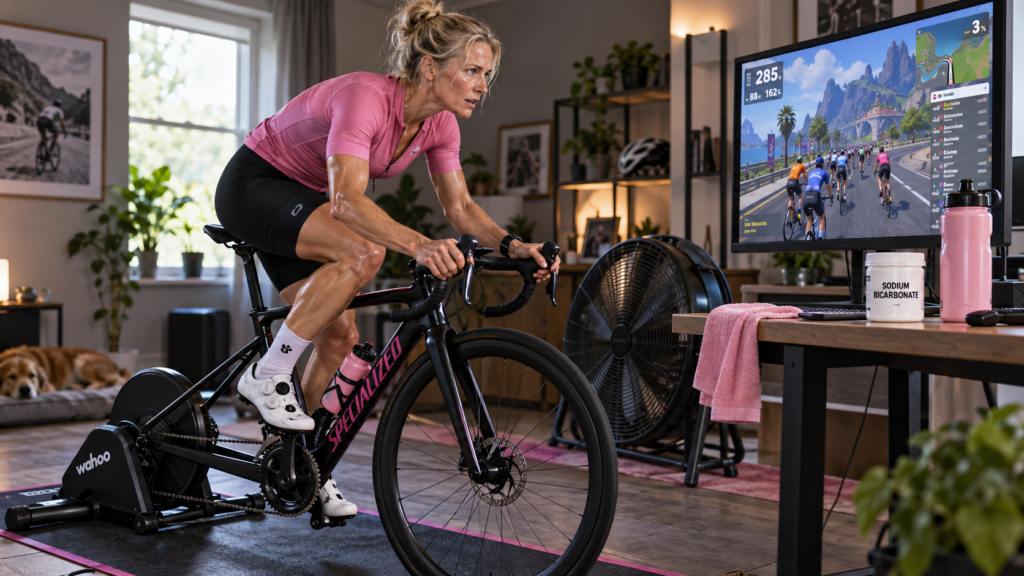
Somewhere in a Zwift group chat, someone eventually asks: “Have you tried bicarb?” It has credible performance research behind it. It also has a reputation for turning a race plan into an urgent trip to the loo. 😅
For a rider considering bicarbonate for Zwift racing, the question is whether any potential benefit during hard efforts is worth the preparation, sodium load, and risk of stomach trouble.
⚠️ Check suitability first. These are research protocols, not a personal dose recommendation. Speak to a doctor before experimenting if you have kidney or heart disease, high blood pressure, a sodium restriction, are pregnant, or take regular medication. A registered sports dietitian can help assess whether it has a useful place in your race plan.
What does it do?
Sodium bicarbonate increases buffering outside the muscle, helping manage acid–base changes during intense exercise. That can support certain high-intensity performances. Fatigue has several causes, though: acidity is not the only reason your legs stop producing the power you want.
The ISSN position stand finds the strongest established evidence in hard efforts lasting roughly 30 seconds to 12 minutes, including repeated efforts. Responses vary; a supplement that helps a study average will not necessarily improve your result.
Where it might fit a Zwift race
- A short climb: a sustained effort of a few minutes that decides whether you remain in contention.
- Repeated accelerations: a race with frequent attacks or punchy terrain and limited recovery.
- A short time trial: an event whose duration and intensity resemble the tasks studied.
Those are applications of the exercise research, not direct evidence that bicarbonate improves Zwift placings. A longer race may still contain decisive short efforts, so total race duration alone does not settle the question. For steady endurance riding, it is a lower priority than fuelling, cooling and pacing.
The quantities are substantial
The position stand describes single doses around 0.2–0.3 g/kg, commonly taken 60–180 minutes before exercise. Those ranges describe studied approaches; the best timing and tolerable amounts vary among people.
At 0.3 g/kg, the arithmetic is 18 g for a 60 kg rider and 22.5 g for a 75 kg rider. Sodium makes up approximately 27.4% of sodium bicarbonate by mass, so 18 g contains about 4.9 g of sodium. Sodium and salt are not interchangeable quantities.
That is a substantial sodium load, not routine electrolyte replacement. Do not estimate it with kitchen teaspoons or confuse bicarbonate of soda with baking powder. A planned protocol needs accurate quantities and the correct product.
Why gut tolerance matters so much
Bloating, nausea, cramps, vomiting and diarrhea can erase any benefit. A 2026 systematic review of gastrointestinal symptoms examines how symptoms vary across protocols. Symptoms often peak around 60–90 minutes after ingestion, but neither their timing nor their severity is predictable for every rider.
The AIS practical guidance discusses spreading ingestion and combining an appropriate protocol with carbohydrate-rich food and fluid. Earlier timing may allow symptoms to settle. None of those strategies guarantees a comfortable race.
Multi-day loading and specialized formulations need their own planning. Smaller portions do not necessarily mean a lower daily sodium intake, and a premium product is not automatically symptom-free.
If you decide to test it
- Use a low-stakes training session. Never make an important race your first trial. Start with professional advice on suitability and protocol.
- Keep the comparison useful. Repeat a familiar workout with similar sleep, food, cooling, and trainer setup. Avoid changing several supplements at once.
- Record the whole outcome. Note the product, amount, timing, meals, gut symptoms, power, and perceived effort. One good session does not prove the supplement caused it.
- Stop if you feel unwell. Severe or persistent symptoms need medical advice; they are not something to push through for a marginal gain.
A useful supplement must help the whole race. Extra power in one effort is no bargain if stomach trouble prevents you finishing.
🚴♀️ Get your indoor racing setup sorted first
Before you worry about buffers and supplements, make sure the basics are working for you – fan, trainer mat, fuel, bottles and a setup you actually enjoy riding. The Indoor Cycling Starter Pack walks you through what really matters, without the fluff.
Is it worth it?
Possibly, for a prepared rider targeting suitable efforts and tolerating a carefully tested protocol. If pacing, fuelling and cooling still need work, put your attention there first. Bicarbonate is optional; a repeatable race routine is the foundation. 🩷

🩷The Endurance Diaries🩷