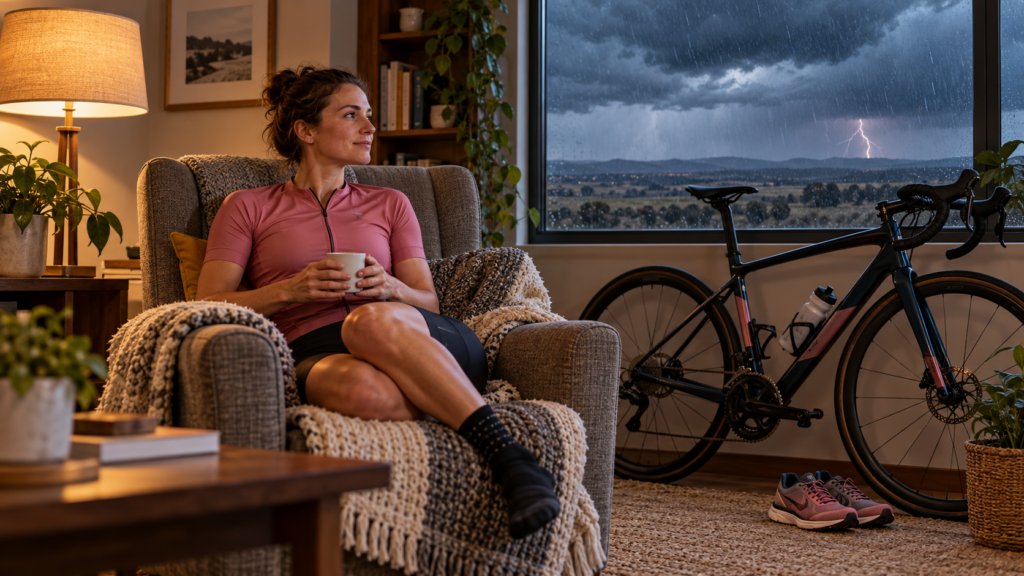
You’ve closed the laptop, found your running shoes, and finally have enough daylight for a decent loop. Then comes that low rumble. The sky is still blue above you. Surely you can squeeze in half an hour?
That rumble is your cue to get to shelter. Lightning safety for cycling and running in South Africa starts with deciding early, before the weather does it for you.
Shelter first, wait, then train. The 45-minute Zwift or treadmill swap below is for after the storm has passed and at least 30 minutes have elapsed since the last thunder. Leave mains-powered exercise equipment alone during the storm.
SAWS’s January 2026 lightning statement identifies Mpumalanga, Limpopo and parts of northern KwaZulu-Natal as areas of particularly high lightning density. It also describes the Highveld’s familiar afternoon and evening summer thunderstorms. That overlaps neatly with the after-work training window. Read the SAWS statement, page 3.
Hear thunder? Stop the session
SAWS puts it plainly:
“If thunder is heard, it means lightning is close enough to pose a danger.”
Don’t wait for rain, a closer flash, or somebody else to call it. Head to a substantial, fully enclosed building or a fully enclosed, hard-topped metal vehicle with its windows closed. An open-sided shelter or golf cart doesn’t qualify. See the indoor shelter precautions below.
Wait at least 30 minutes after the last thunder before resuming outdoor activity. Each new rumble restarts the clock. A break in the rain is not an all-clear. SAWS, page 4.
Your indoor Plan B needs one important rule
During an active thunderstorm, leave mains-powered exercise equipment alone. The National Weather Service advises avoiding electrical equipment and cords, plumbing, windows, and open garages. It also says not to unplug equipment during the storm. Applied to training, that means saving the powered trainer or treadmill session for afterward and unplugging equipment in advance; that is part of your preparation. Indoor lightning precautions.
You can simply rest while the storm passes. Stay away from windows and plumbing, and save the post-workout shower for afterward. The goal is to arrive safely tomorrow.
Dry doesn’t necessarily mean safe
- Trees: lightning can jump from a struck tree to someone nearby, and current can spread through the ground.
- Gazebos, tents and picnic shelters: a roof that keeps rain off isn’t adequate lightning protection.
- Hilltops, n’telines and open fields: these leave you exposed. Don’t stop there to watch the storm.
- Dams, pools and streams: get away from the water and into proper shelter.
The CDC’s lightning guidance and the National Weather Service explain these risks and how lightning strikes people. Your helmet, bicycle tyres and running shoes are not a shelter plan.
Caught on an exposed trail or road?
Keep moving towards proper shelter. Don’t lie flat. Stop treating it as a workout and focus on getting out of danger.
- Move away from exposed high ground, isolated trees, fences, and water.
- If you’re in a group, spread out rather than bunching together.
- No outdoor position is safe in a thunderstorm. Reaching proper shelter remains the priority.
A note on crouching: if shelter is unavailable, SAWS (page 4) advises crouching low with feet together and minimal ground contact. The US National Weather Service no longer recommends it because it offers inadequate protection and can create false confidence. Don’t let crouching delay reaching shelter.
For your next route, identify actual buildings or vehicle access beforehand. “We’ll find somewhere” is a weak plan on a remote trail.
Make the group decision before you leave
For a club ride or social run, I’d agree on three things at the start: who calls the stop, where everyone will shelter, and how you’ll confirm that everyone is accounted for.
- Anyone should be able to raise the alarm. Nobody needs to defend abandoning a segment or cutting a run short.
- Regroup and count heads once sheltered, rather than waiting for slower riders in an exposed meeting spot.
- At parkrun or an organized event, follow the team’s safety instructions and cancellation notices. Don’t pressure volunteers to keep things going for your result.
- Make space for walkers, newcomers and anyone without transport in the escape plan.
Those are practical group recommendations, not a replacement for an event’s own emergency procedure.
Check the forecast before you lace up
Check your location’s forecast and the relevant warning area and time on the SAWS website and its warnings page. Check again near departure. A forecast helps you plan; thunder means act, even without a phone alert.
The January SAWS release describes a buffer-zone lightning alert service and gives info4@weathersa.co.za for enquiries. Clubs and organisers can ask about coverage, delivery, pricing and setup; don’t assume it is a free, automatic alert for every runner. Service details, page 5.
A ready-made 45-minute swap for after the storm
Once the storm has passed and at least 30 minutes have elapsed since the last thunder, this is my suggested replacement for an easy ride or run. Shorten it if you’ve already done some training outdoors.
| Time | Bike or Zwift | Treadmill |
|---|---|---|
| 0–10 minutes | Start gently and settle into comfortable pedaling. | Walk, then build gradually to your usual easy jog. |
| 10–35 minutes | Ride steadily at a conversational effort. Ignore sprints and other riders’ pace. | Jog easily, using walk breaks whenever needed to keep it comfortable. |
| 35–45 minutes | Gradually ease down to a very gentle spin. | Slow down gradually and finish with comfortable walking. |
For an established cyclist, use your familiar easy endurance range. Don’t chase a universal heart-rate number or try to turn the canceled ride into a fitness test. The aim is manageable aerobic training with little extra fatigue. It won’t replace a long ride, a race, or a specific interval session minute for minute.
New to the setup? Start with How to Start Indoor Cycling in South Africa. For the bigger training picture, read Zone 2 for Time-Crunched Cyclists. And if you want fresh scenery, our Wild Isles route guide can help you choose. Ride to the time limit; completing a route badge is optional.
No indoor equipment? Take a rest day or do a short, familiar mobility routine indoors. There’s no need to manufacture 45 minutes of hard exercise to make up for the weather.
🚴♀️ Get your storm-season Plan B sorted
Thinking of setting up an indoor trainer before the next afternoon storm rolls in? The Indoor Cycling Starter Pack in the shop is a good place to start.
If someone is struck by lightning
- Check for continuing danger and call for help immediately. In South Africa, dial 112 from a cellphone or 10177 for an ambulance. Give your location, access point, and number of people affected. South African emergency numbers.
- They do not retain an electrical charge. You can touch them to give first aid, while remaining alert to the ongoing storm.
- If they’re unresponsive and not breathing normally, begin CPR. Follow your training and the emergency call handler’s instructions. If trained, include rescue breaths; if unable to give breaths, provide chest compressions. Use an AED if available and follow its prompts.
- Get medical assessment even if they appear to recover. Keep checking their breathing and responsiveness while help is on the way.
First-aid guidance: CDC lightning safety and resuscitation · Red Cross lightning first aid.
Save the emergency numbers and your likely shelter points before your next outing. A storm-season Plan B is much easier to use when you’ve already made it.

🩷The Endurance Diaries🩷