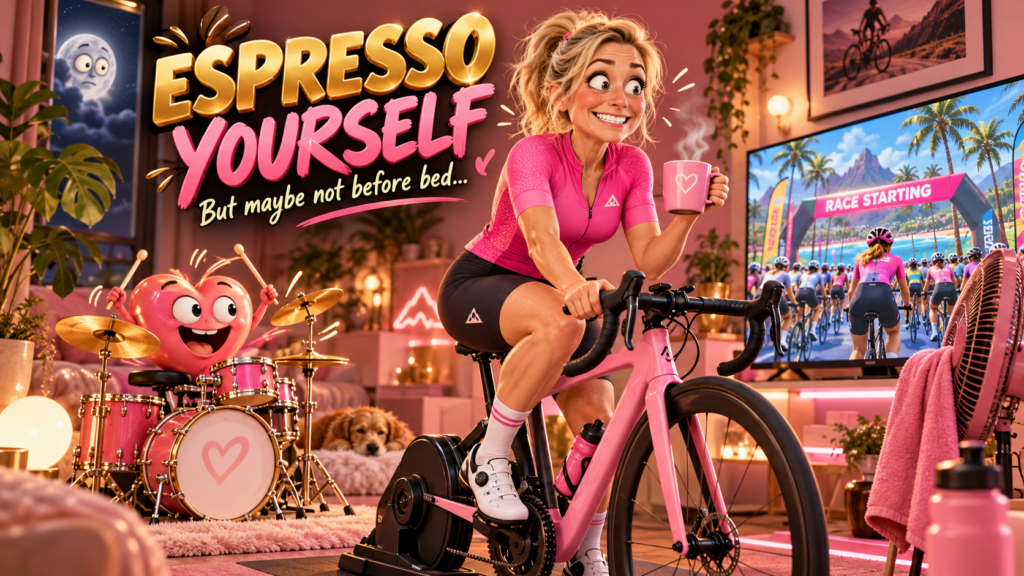
I have a confession. For years, my “race-day caffeine strategy” was: drink whatever coffee was left in the plunger, panic, warm up badly, and then wonder why my heart was doing a drum solo before the pens even opened. ☕😅
Then a study published in September — and picked up by Psychology Today this week — made me sit down and look at the numbers properly. And for a woman weighing 60-something kilograms, those numbers look quite different from the “just have a strong coffee” advice many of us got from the boys in the bunch.
So let’s talk about caffeine for women cyclists: what the new research found, what it didn’t, and why your body weight, the pill, and your sleep all deserve a seat at the table.
🩺 Quick but important: I’m a rider, not a doctor or dietitian. This article is general information, not medical advice or a dosing prescription. If you’re pregnant or trying to fall pregnant, breastfeeding, on medication, or you have any heart, blood pressure, anxiety, or sleep concerns, please chat to your doctor before using caffeine to boost performance.
What the new caffeine study actually found ⚡
Researchers at the University of Tsukuba in Japan (Nishikawa, Shibasaki and Fujii) published a randomized, double-blind study in Medicine & Science in Sports & Exercise on 1 September 2026. Psychology Today covered it on 6 October.
Here’s the short version:
- 12 healthy young adults (4 of them women) took either 5.5 mg/kg of caffeine or a placebo.
- About an hour later, they did three sets of repeated sprints on a bike — six 5-second all-out efforts per set — spread over 3.5 hours.
- With caffeine, average sprint power was roughly 0.5–2.4% higher, and peak power up to 3.7% higher in the later sets.
- The effect was still measurable 3.5 hours after the dose.
- Riders rated the efforts as feeling easier and their legs as hurting less. Their heart rates were higher, though.
A 2% bump might not sound like much, but small margins can matter in racing. Whether a lab result like this translates into holding a wheel over a Zwift KOM is a different question — and this study wasn’t designed to answer it.
…and what it didn’t tell us 🤔
- It’s small. 12 people, only 4 women. That’s nowhere near enough to say anything specific about female riders.
- One dose only. They didn’t compare different doses, so we can’t tell from this study whether a lower dose would have worked.
- Short sprints, not a race. Five-second bursts in a lab aren’t the same as a 45-minute crit on Watopia with surges every 90 seconds.
- Young, healthy adults. If you’re in your 40s or 50s, on the pill, peri-menopausal, or caffeine-sensitive, you’re outside the study group.
A bigger review of 20 cycling studies, published in January in Frontiers in Nutrition, adds useful context. It suggests lower doses (around 3 mg/kg) can improve cycling time-trial performance, without a clear additional benefit from higher doses. That review looked at time trials rather than all-out sprints, though, and it didn’t set out to measure side effects.
Do the maths: what research doses look like for your body 🧮
Sports research almost always gives caffeine per kilogram of body weight. That’s why “one strong coffee” means something completely different for a 55 kg rider than for an 85 kg guy who’s been mainlining espresso since varsity.
Here’s what the doses used in research look like at different body weights. These are research doses, not a recommendation for you to take.
| Body weight | Lower research dose (3 mg/kg) | This study’s dose (5.5 mg/kg) |
|---|---|---|
| 55 kg | ±165 mg | ±300 mg |
| 65 kg | ±195 mg | ±360 mg |
| 75 kg | ±225 mg | ±410 mg |
Translating milligrams into coffee is trickier than it sounds:
- ☕ A mug of filter or plunger coffee: about 80-150 mg, depending on the beans, the brew, and the mug.
- ☕ A single espresso shot: roughly 60–80 mg.
- 🧃 Caffeinated gels: often between 25 and 100 mg each.
- 💊 Caffeine tablets: commonly 100 or 200 mg per tab — precise, but also the easiest to overdo.
Because home-brewed coffee varies so much, “two mugs” could be anywhere from about 160 to 300 mg. If you want to know what you’re actually taking, labeled products (gels, tabs, some energy drinks) are more predictable than your plunger. Always check the label.
Where the safety guidance fits in
The European Food Safety Authority (EFSA) says single doses up to 200 mg, and up to 400 mg spread over a day, raise no safety concerns for healthy, non-pregnant adults. For pregnancy and breastfeeding, the daily figure is 200 mg.
That 200 mg isn’t a cliff edge where caffeine suddenly turns dangerous. It’s the level where the experts are confident there’s no concern for healthy adults. Above it, the evidence is simply less reassuring, and individual responses vary more.
Here’s the catch: for many women, even the lower research dose sits close to or above that 200 mg mark. At 75 kg, 3 mg/kg is about 225 mg. So 3 mg/kg is a number researchers use — not a universal starting point. If you’re curious about caffeine for racing, it’s worth chatting to a doctor or sports dietitian about what makes sense for you.
Why more caffeine isn’t automatically better 😬
Caffeine is one of those things where more isn’t automatically better, and the downsides can show up long before any extra benefit does:
- Jitters and shaky hands — not ideal when you need to hit the PowerUp button at exactly the right moment.
- A racing heart — the study itself showed heart rate going up. Add race nerves, and that can feel properly unpleasant.
- Tummy trouble — caffeine can get things, um, moving. Mid-race is not the time.
- Wrecked sleep — this is the big one. Many Zwift races we do in South Africa are evening events, and EFSA notes that even 100 mg close to bedtime can affect sleep for some people. A flat, under-slept you won’t train well tomorrow.
The best caffeine dose isn’t the biggest one. It’s the one your body handles well — on the bike and in bed afterwards.
The women-specific bits nobody tells you 🩷
The pill slows caffeine down
This one surprised me. Estrogen-containing birth control pills slow down the liver enzyme that clears caffeine. In one older study, the time to clear half of a caffeine dose increased from about 5.4 hours to nearly 8 hours in women on the pill. Another found caffeine clearance roughly halved after just one cycle on a combined pill.
What that does — and doesn’t — mean:
- Caffeine stays in your system longer. That’s well established.
- Whether that gives you a longer or stronger performance benefit hasn’t been shown. Caffeine hanging around in your blood isn’t the same as it helping you ride faster.
- What it does make more likely is poorer sleep after an evening race, and feeling more wired from an amount that used to feel fine.
Not all hormonal contraception works the same way, so if you’re unsure how yours fits in, your doctor or pharmacist can tell you in two minutes.
Track how it feels — for you
The research on whether the menstrual cycle changes how you respond to caffeine is mixed. Plenty of us do notice we feel more anxious, jittery, or sleep worse at certain times of the month — but sleep, food, stress, and how hard the session was can all play a part too.
A training log can help you spot patterns in your own response, alongside what research tells us. Note the amount, timing, your cycle day, what you ate, how you slept the night before, how hard the session was, and how you slept afterward. Over a few months, you’ll start to see what’s actually going on. 📓
Long Zwift races: what about a top-up? 🚴♀️
The “still measurable at 3.5 hours” finding is interesting, but it’s worth using it with caution. This was a small study of short, repeated sprints with rest in between — not a long, continuous race. It doesn’t tell us how long a single dose would help during a real event, or whether a top-up would add anything.
If you’re thinking about caffeine for a longer event like a Tour of Watopia stage or a team time trial, a few honest points:
- Count everything. Morning coffee, pre-race coffee, caffeinated gels, tablets, energy drinks, even caffeinated drink mixes — it all adds up to one total.
- Doses stack. Caffeine from earlier in the day may not have cleared yet when you take more, especially if you’re on the pill. Splitting doses doesn’t guarantee a smaller hit in your system.
- Some riders save caffeine for later in a long event, when the hard racing happens. If that appeals to you, test it in a long training ride first and keep your total in mind.
If you’re building a full race-day plan, I’ve also written about bicarbonate for Zwift racing (useful for buffering or an upset stomach?) and when to take protein powder and creatine. Please don’t try them all for the first time on the same day. Your stomach will file a formal complaint. 😂
If you want to experiment: test it in training first ✅
The golden rule: nothing new on race day. If you and your doctor are comfortable with you trying caffeine for performance, here’s a sensible way to approach it:
- Start with what you already know. Begin with an amount you already have on a normal day without problems — not a study dose.
- Count your daily total. Coffee, gels, tabs, energy drinks, and everything else, including what you had earlier that day.
- Pick a hard training session, like intervals or a sprint workout, rather than an easy spin.
- Keep the timing consistent — roughly an hour before, the way you’d do it on race day.
- Write it down: amount, timing, food, sleep the night before, cycle day, how the session felt, any jitters or tummy issues, and how you slept afterward.
- Repeat a few times before drawing conclusions. One session is a data point, not a pattern.
- Watch the clock for evening races. If your sleep takes a knock, cut back or skip it for late starts.
And if caffeine makes you feel awful? That’s useful information too. It’s a tool, not a requirement. Plenty of strong riders race brilliantly on a good warm-up and a properly fuelled day. 🩷
Please see your doctor first if you have heart rhythm issues, high blood pressure, anxiety, a sleep disorder, are pregnant or breastfeeding, or take any medication that might interact with caffeine.
📓 Want a simpler way to track your training?
Caffeine is the cherry on top. The cake is a setup that works, a plan you can stick to, and a log that shows you what’s really going on. The TED shop has practical, printable tools for real riders training around real lives.
Final thoughts ☕
The new study is genuinely interesting. Caffeine was linked to slightly higher sprint power, efforts felt easier, and the effect remained measurable hours later. But it was 12 people, mostly men, doing short sprints on one fairly big dose.
For us, the smarter move is to treat the research doses as context rather than a prescription, count all your caffeine, factor in the pill, protect your sleep, and get proper advice if you have any health concerns. Your body isn’t a lab average. Learn how it responds.
Tell me in the comments: are you a pre-race coffee girl, a caffeine gel girl, or a “no thanks, my nerves are stimulant enough” girl? 😂👇
Sources: Nishikawa M, Shibasaki M, Fujii N. Medicine & Science in Sports & Exercise, 2026 (study) · Effect of caffeine ingestion on cycling performance: a systematic review and meta-analysis. Frontiers in Nutrition, 2026 (review) · Abernethy DR, Todd EL. European Journal of Clinical Pharmacology, 1985 (pill and caffeine half-life) · Balogh A et al. European Journal of Clinical Pharmacology, 1995 (pill and caffeine clearance) · EFSA Scientific Opinion on the safety of caffeine, 2015 (guidance)

🩷The Endurance Diaries🩷