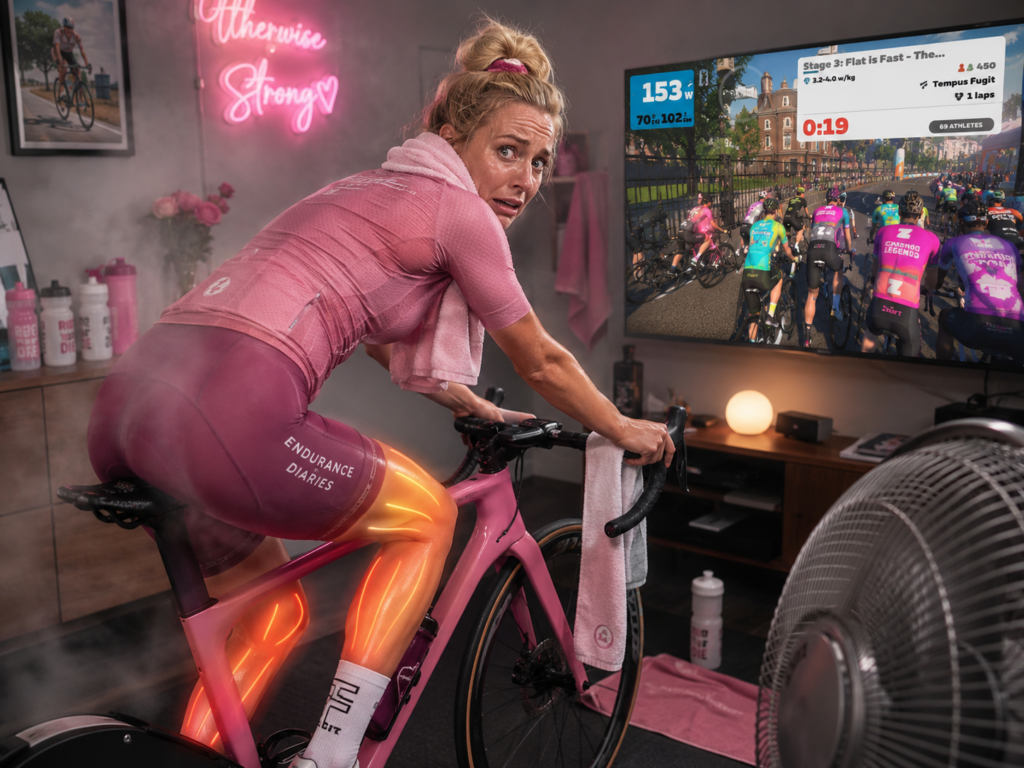
There is a special kind of confidence that arrives about five minutes before a Zwift race.
You have done three hard efforts. Your fan is on. Your legs feel spicy. You are sweating like the race has already started, which is actually a bit suspicious, but you choose to call it preparation. For one beautiful moment, you feel completely ready.
Then the banner drops, the pack launches, and your legs quietly ask why you used the good watts in the warm-up.
A warm-up is supposed to prepare you for the race. It is not supposed to become the first race of the evening. 🚴♀️
Why warming up actually matters on Zwift
Most outdoor rides give you a natural settling-in period. You roll away, greet your neighbours, narrowly avoid a pothole, and gradually find your legs. Zwift racing is considerably less polite.
The first minute can include a hard launch, a fight for position, and a short climb — all before your body has finished reading the terms and conditions. Starting completely cold makes that opening feel worse than it needs to.
A proper warm-up gradually raises muscle temperature, increases blood flow, and prepares all the systems involved in producing power. Research generally finds that warming up improves performance — but here is the part most of us skip past: more intensity is not automatically better.
The two warm-up mistakes (and yes, both are happening)
1. Starting almost cold
You log in late because of life. You discover your heart-rate monitor has started a private rebellion. You join the pen with two minutes to spare and quietly decide that adrenaline is basically a performance-enhancing substance, and this will be fine.
Sometimes it is fine. More often, the opening surge feels genuinely shocking, your breathing jumps ahead of your legs, and you spend the first few kilometres trying to recover while everyone else is already fighting for position. Not ideal. Not your best look either.
2. Doing entirely too much
The opposite mistake looks much more professional, which is part of the problem.
You ride for 30 minutes. You do several long threshold efforts. Then a sprint. Then another sprint, just to verify that the first sprint was sufficiently sprinty. You end with a few confidence-building openers. By race time, you are warm, activated, very ready to go home, and slightly cooked.
This matters most when the race itself is long, when you are already carrying training fatigue, or when your recovery between hard efforts is — how do I say this — not your strongest quality.
The goal is not to win the warm-up. The watts you use in the pen are not refundable.
A simple 15-minute Zwift race warm-up that actually works
This is a practical starting point, not a rule engraved on a smart trainer. Think of it as a sensible default while you figure out what your own legs actually prefer. 🩷
Minutes 0–5: Easy spinning
Ride comfortably. Let your cadence rise naturally. Use this time to confirm that your trainer, heart rate monitor, fan, and internet connection are all present and working. This is also your opportunity to fix whatever the Bluetooth decided to do tonight.
The goal is simply to stop feeling like you just walked in from the kitchen — which, to be clear, you probably did.
Minutes 5–9: Build gradually
Move from easy endurance effort towards something approaching tempo. Keep it controlled. You should feel warmer and more awake, not like you have already started paying interest on your energy debt.
Minutes 9–12: Two short race-openers
Do two efforts of roughly 20–30 seconds near the power you expect during the opening surge. Spin them easily for at least 60–90 seconds. These are reminders, not fitness tests. You do not need a new personal best in the pen. The pen is not where personal bests live.
Minutes 12–15: Settle down
Ride easily. Take a drink. Let your breathing return to something your heart rate monitor does not find alarming. Join the pen early enough to avoid a last-minute technology crisis, which I say with the full knowledge that the technology will probably still find a way.
Adjust it for the actual race
Not all Zwift races are born equal. Your warm-up should not be either.
Short, explosive race
A crit or a short route with an immediate climb may justify one extra brief opener. Keep it short and allow proper recovery afterwards, or you will arrive at the start already wearing a slightly haunted expression.
Longer race or team time trial
The warm-up can be calmer. You still want to be ready for the start, but preserving energy over 40–60 minutes matters considerably more than proving something in the 15 minutes beforehand.
Morning race
You may need a little more gradual riding because your body has been unconscious and horizontal for several hours. Do not confuse needing more time with needing more intensity. They are not the same thing, and the distinction is important at 6 a.m.
When your legs already feel terrible
If your legs feel heavy going into the warm-up, one more hard effort is not always the answer. Sometimes the useful piece of information is simply that you are tired. Keep the warm-up gentle, and reconsider your race goal if your body still feels off at minute ten. Your legs are not being dramatic. They are communicating. Listen occasionally.
How to find your own best warm-up
Take three comparable races and test one small change at a time. Because changing three things at once and then wondering which one helped is a very popular way to learn absolutely nothing.
- Record the warm-up duration and any hard efforts
- Note how the first five minutes of the race actually felt
- Check whether you could hold the position without an unusually high perceived effort
- Note whether your legs felt ready — or already quietly resentful
- Consider sleep, food, room temperature and recent training load before blaming the warm-up entirely
Do not judge the warm-up only by your final placing. Pack strength, route, tactics, and whoever decided to just sit on your wheel for 20km before attacking can all change that result. The better question is whether the warm-up helped you reach the first decisive moment without already spending your best watts at the start.
My next-race test
My current warm-up habit is best described as “roll the legs and hope the engine wakes up” 🚴♀️😅. I usually do spin, but not always with enough sharp race-style efforts before the start. So I end up in the pen with legs that are technically warm but emotionally unprepared for what is about to happen.
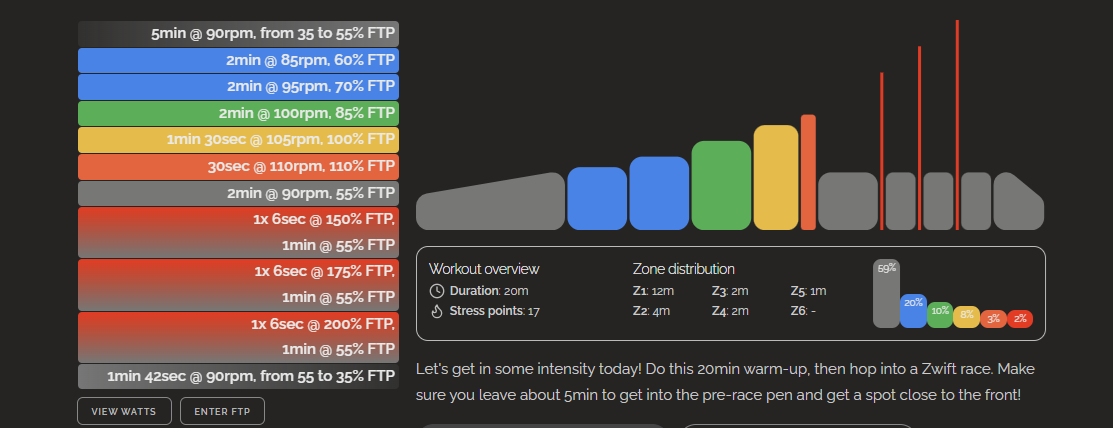
Next race, I am testing something more structured — a proper build through the zones, a couple of short high-power bursts to remind my legs that we are not, in fact, going for a casual Sunday spin, and then an easy wind-down before the pen. Think less sleepy diesel, more race-ready toaster legs.
Something like this 20-minute Zwift warm-up workout actually maps it out perfectly: steady build through the zones, three short openers at 150%, 175%, and 200% FTP, and then a proper cool-down to settle before the start pen. It even reminds you to get into the pen five minutes early. The attention to detail is frankly more organised than I am.
I will report back honestly. If toaster legs turn out to be worse than sleepy diesel, you will be the first to know.
That personal experiment is what turns a general warm-up into your warm-up. Some riders need more time. Some need fewer openers. Some need to stop trying to prove fitness before the event has begun. The goal is to arrive at the start warm enough to race and fresh enough to still have opinions after kilometre thirty.
🚴♀️ New to Indoor Cycling or Zwift? Here’s What You Actually Need
Before you spend a fortune on things that sound important but turn out to be optional extras, here is the honest starter list. No fluff. No “invest in your journey” energy. Just the stuff you actually need to get pedalling.
🛠️ The Essentials (you cannot skip these)
- A bike — road, MTB, or even that thing gathering dust in the garage 🚲
- A smart trainer or turbo trainer — smart trainers control resistance automatically; basic turbos just hold your bike still while you suffer manually. Either works to start. Search Takealot | Search Amazon
- A laptop, PC, tablet, or Apple TV — to run Zwift. Older devices work fine. Your phone also works but the screen will make you squint like you’re reading fine print in a wind tunnel.
- A Zwift account — free trial available at zwift.com. After that it’s a monthly subscription. Worth it. Mostly.
- A fan — not optional. You will overheat faster than you expect. Any fan will do. The bigger the better. Borrow one from the kitchen if you must. Search Takealot | Search Amazon
- A mat under your trainer — protects your floor from sweat. Yes, it gets that sweaty. No, you are not special. Search Takealot | Search Amazon
- A sweat towel — you know why.
🎧 Nice to Have (upgrade when you’re hooked)
- Heart rate monitor — helps track effort and makes your Zwift profile look like you know what you’re doing. Search Takealot | Search Amazon
- Cadence or speed sensor — useful if your trainer doesn’t already broadcast this data. Search Takealot | Search Amazon
- Cycling shorts with a chamois — your backside will thank you after ride 3. Trust this advice. Search Takealot | Search Amazon
- A small table or riser for your screen — neck position matters more than you think. Anything that gets your screen to eye level works, including a stack of cookbooks.
- Cycling shoes + cleats — eventually you’ll want these. Not essential on day one. Search Takealot | Search Amazon
🇿🇦 SA-Specific Tip
Load shedding and Zwift do not get along. Consider a small UPS (uninterruptible power supply) or a laptop setup so a scheduled outage does not kill your mid-race effort right before the sprint. Ask me how I know. 🕯️ Search UPS on Takealot
All links above are provided for convenience — I am not sponsored by any of these retailers (yet 😅). Prices and availability vary, so always compare before you buy.
The short version
Your warm-up should open the door for your best watts. It should not collect them at the entrance.
Arrive warm enough to race. Stay fresh enough to finish. And if the Bluetooth still refuses to connect at minute fourteen, that is unfortunately not a warm-up protocol issue. That is just Tuesday on Zwift.
Start warm. Finish strong. Do not give your best sprint to the pen.
Enjoyed this one?
There is more where this came from – real training stories, Zwift lessons, running honesty and practical endurance notes from South Africa.
- Read more honest race and training stories
- Follow the messy middle of getting fitter, stronger and more consistent
- Send a message if something in this post sounded familiar
Got a warm-up question or something that worked brilliantly (or spectacularly didn’t)? Drop it in the comments or send me a message at hello@theendurancediaries.co.za — I genuinely love hearing from real riders. 🩷

🩷The Endurance Diaries🩷