The first time I tried to set up an indoor cycling bike, I sat on the floor for forty-five minutes trying to figure out why my trainer wouldn’t talk to my phone. I had three browser tabs open. I had watched two YouTube tutorials. I had a level of frustration that genuinely surprised me.
And eventually I just gave up and made tea.
If you’re standing where I was — staring at a trainer, or thinking about buying one, or wondering whether Zwift is worth it — this is the guide I wish someone had written for me.
This isn’t a 5 000-word pro-cyclist breakdown. It’s an honest, practical look at how to actually start indoor cycling in South Africa without spending half your salary or losing your mind to setup.
Let’s get into it.
Why indoor cycling, anyway?
I’ll be straight with you. Outdoor riding in South Africa isn’t always easy.
There’s traffic. There’s safety. There’s weather. There’s load shedding messing with your morning plans. There’s work, kids, and the fact that the sun goes down at 5pm in winter.
Indoor cycling solves a lot of that.
You can ride at 5am or 10pm. You can train in any weather. You can squeeze 30 to 45 minutes between meetings or after the kids are in bed. And you can get genuine, measurable fitness without leaving your house.
It’s also surprisingly fun once you get going — especially with Zwift, which I’ll get to in a moment.
Do you really need Zwift?
Short answer: no, but it helps.
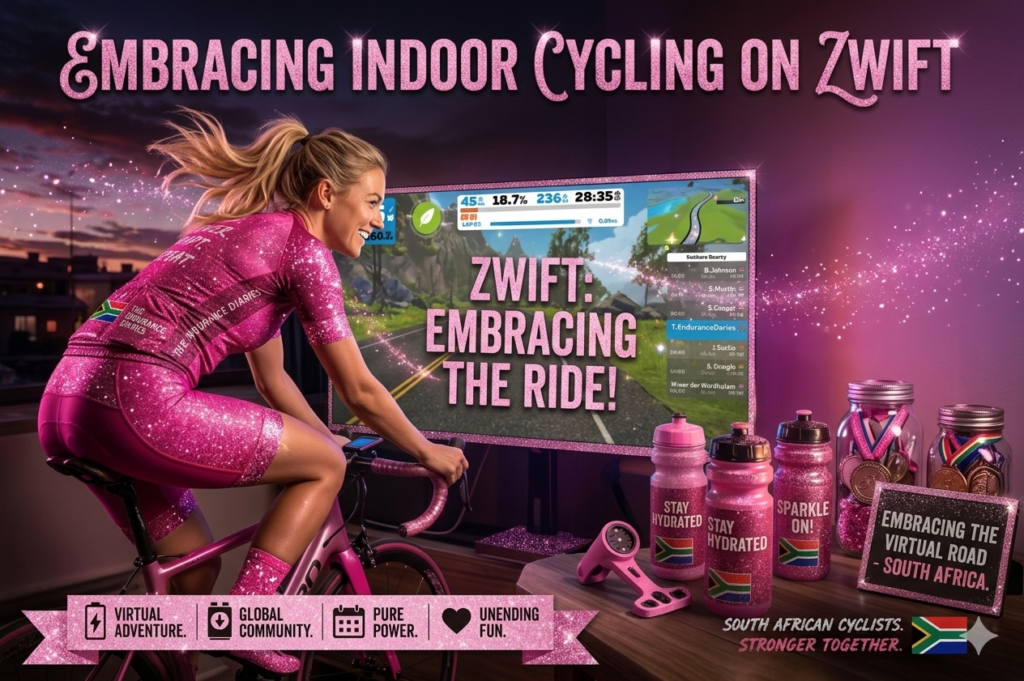
Zwift is the most popular indoor cycling platform in the world, and the South African community is much bigger than you’d think. It turns a stationary trainer into a virtual world. You ride routes, join group rides, race, and follow structured workouts — all from your phone, tablet, or laptop.
Other platforms exist (Rouvy, MyWhoosh, TrainerRoad), but Zwift is the most beginner-friendly. It has a free trial, the monthly cost sits around R270, and there’s a real social side you don’t get with the others.
If you’re starting, start with Zwift’s free trial. Test your setup. See if you actually use it. Then decide whether to subscribe.
What you actually need to start
Right. The gear question. Here’s the truth nobody tells you when you’re new:
You can start with under R3 000 if you already own a bike.
That’s it. The marketing makes it sound like you need an R20 000 setup. You don’t.
Here’s the bare minimum:
- A bike — any bike. Mountain, road, hybrid, doesn’t matter.
- A basic wheel-on trainer. Second-hand options work. New basic models like the Tacx Blue Matic sit around R2 500.
- A speed sensor (~R600 if your trainer doesn’t have one built in).
- A phone or tablet to run Zwift on.
- Zwift’s free trial.
That setup will get you riding. Not beautifully, not luxuriously, but functionally. And it’s enough to find out if indoor cycling is for you before spending more.
If you have more budget (R10k–R18k)
The big upgrade is moving from a wheel-on trainer to a direct-drive smart trainer. Names to look for: Wahoo Kickr Core, Tacx Flux S, Elite Suito. These cost more but change everything — your power readings become accurate, the trainer adjusts resistance automatically on hills, and Zwift feels real.
This is where most people land in the long term. The wheel-on is for testing the waters. The direct drive is for committing.
What you don’t need yet
- A power meter (your smart trainer measures power)
- Special cycling shoes (regular trainers are fine for month one)
- An expensive heart rate monitor
- A dedicated “pain cave” room
Honestly, ignore Instagram. Most pretty setups you see cost the owner more than their car. You don’t need any of it.
Setting up your space (even if it’s tiny)
You don’t need a garage. You don’t need a spare room. You need:
- A hard, flat surface (tile, laminate, concrete — or carpet with a thick mat)
- About 2 metres by 2 metres of floor space
- Ventilation — a window, a door, ideally a fan
- A nearby plug
- A spot to put your phone or screen
A corner of your lounge works. A balcony works. A garage works. I’ve seen people ride in actual hallways.
What you absolutely must get is a fan. I’m serious. Indoor cycling generates so much heat that without a fan, a 45-minute ride feels like an hour in a sauna. You will sweat more in 45 minutes indoors than in two hours outdoors.
Two towels — one for your face, one over the frame to protect it from sweat — and a sweat mat under the trainer round out the basics. Total cost: under R500.
The load shedding question
Welcome to South Africa. Here are your options when Eskom isn’t cooperating:
- Schedule around it. Check the EskomSePush app and plan rides during non-load-shedding windows. Boring but free.
- Inverter setup. If you already have one for the rest of your home, your trainer plugs into the same battery backup. Most basic systems can run a laptop, a trainer, and a small fan during stage 4.
- Phone-only Zwift. Your phone runs Zwift just fine on mobile data. A fully charged phone + Bluetooth trainer = ride happening regardless of grid status. Plan for about 100–200MB per ride.
- Offline structured workout. If you have a planned interval session, you don’t need Zwift’s visuals at all. Ride to a stopwatch and your trainer’s resistance.
- Don’t ride. Rest. Some days, the best workout is a stretch session or a walk. Recovery is also training.
I’ve used all five at some point. Consistency matters more than perfection. A 20-minute ride done beats a 90-minute ride skipped, every time.
Your first ride: what to expect
The biggest beginner mistake is overthinking the first ride.
Don’t do a workout. Don’t try to race. Don’t worry about your FTP (we’ll come back to that).
Just open Zwift, pick “Free Ride” in Watopia (the main virtual world), and pedal for 20 to 30 minutes. Look around. Feel how the trainer responds when you hit a hill. Wave at other riders by tapping the “Ride On” thumbs-up. See what happens when you pick up a power-up.
That’s it. Get familiar. The first ride is a friendship-building exercise between you and your setup.
What you’ll learn:
- How your trainer’s resistance changes on inclines
- How drafting works (sitting behind another rider makes it easier)
- The Zwift display — power, heart rate, cadence, distance
- That 30 minutes feels longer indoors than you think (it just does)
Common beginner mistakes I made (so you don’t have to)
- Doing too much too soon. I tried to ride five days a week from day one. Two or three were plenty. Start small, build slowly.
- Skipping the fan. Already mentioned. Cannot overstate. Get the fan.
- Comparing power numbers. Someone always has better watts than you. Race yourself, not the leaderboard.
- Ignoring saddle sores. Get proper bib shorts. R600 to R1 200 well spent.
- Riding too hard on easy days. If a workout says easy, ride easy. Save the effort for structured sessions.
- Forgetting to drink. You sweat way more indoors. 500ml minimum per hour.
- Trying to race in week one. Build base fitness first. Races will still be there in month three.
Shop The Endurance Diaries gear
If this article helped, have a look at my online shop. It has endurance-inspired gear and everyday training favourites for Zwift rides, running days and coffee-fuelled comeback stories.
- Coffee mugs, bottles, towels and practical training accessories
- Running, cycling and endurance-inspired apparel
- South African checkout and delivery
- Secure PayFast payment through The Endurance Diaries website
- New products added as the shop grows
No pressure, no hard sell – just a small way to support the diary and bring a little sparkle to your next session.
Final thoughts
Indoor cycling has completely changed how I train. It’s the most consistent training I’ve ever done — even through winter, even through load shedding, even on weeks when life is overwhelming.
You don’t need to be fast. You don’t need to look the part. You don’t need an expensive kit.
You need to start. And then keep going.
If this helped, I would love to hear from you. Drop a comment, tag me on Instagram, or send me an email at my.endurance.diaries@gmail.com. You can also read more stories on the blog.
— Liz
💖The Endurance Diaries 💖