It’s a familiar cycling dilemma. You’re 90 minutes into a long ride, your legs are filing a formal complaint, and you reach into your back pocket for an energy gel… only to remember you left it on the kitchen counter. Next to your sunglasses. And your dignity.
But wait. What’s that crinkly thing at the bottom of your jersey pocket? A half-squashed packet of gummy bears from three rides ago. 🍬
So, can gummy bears actually fuel your ride? Yes — they can supply useful carbs. Whether they’re the right fuel depends on the ride, the portion and how well you tolerate them. Let’s look beyond the tiny bear faces.
What’s Actually Inside a Gummy Bear? 🐻
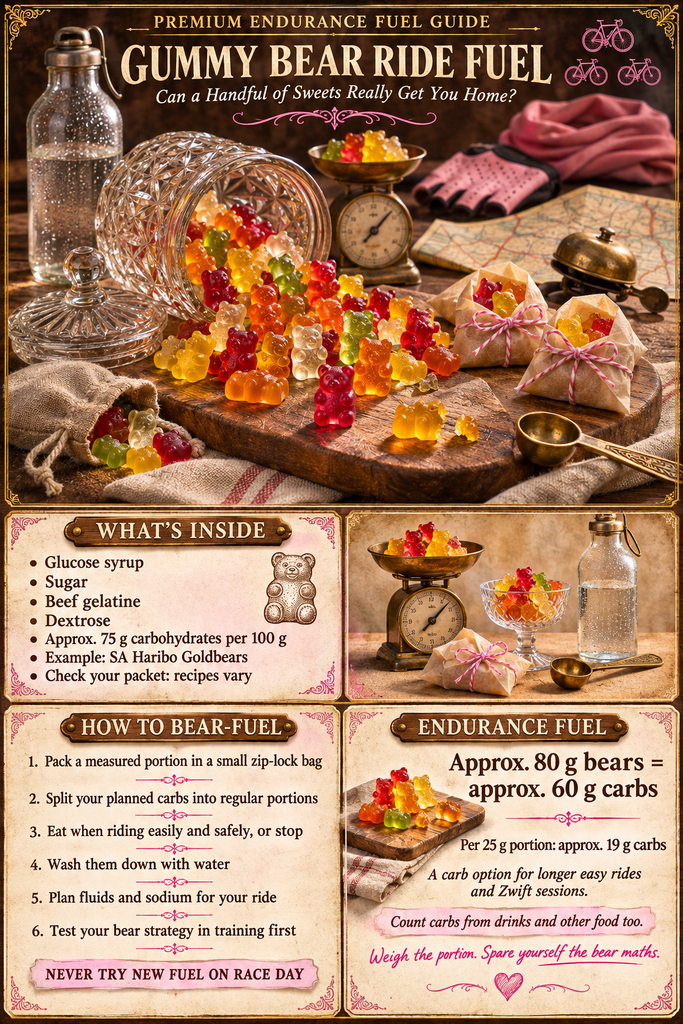
Let’s flip the packet over like responsible adults. On the South African Haribo Goldbears label, you’ll find roughly 75 g of carbohydrates per 100 g, or about 19 g per 25 g serving.
The main ingredients on that label? Glucose syrup, sugar, beef gelatine and dextrose. Translated from Label into cyclist terms, that’s basically: fast sugar, more fast sugar, the wobbly bit, and a little extra fast sugar for good measure.
Like many energy gels, gummy bears supply readily available carbohydrates. But gels offer a measured dose without the chewing, and some use specific carbohydrate blends for higher intakes. The bears win on tiny smiles, not necessarily convenience. 😊
Quick note: these figures are for SA Haribo Goldbears, not all gummies. Check your packet’s nutrition and allergen information. This version contains beef gelatine and may contain traces of milk and wheat.
So… How Many Bears Is That Per Hour? 🧮
For endurance rides lasting roughly 1–2.5 hours, a common guideline is 30–60 g of carbohydrates per hour, adjusted to the effort and your needs. Rides beyond about 2.5–3 hours may benefit from up to 90 g per hour, using a glucose–fructose mix and a practised fuelling plan. That isn’t a target for every easy spin, and a gummy label doesn’t tell you its glucose-to-fructose ratio.
Using that SA Goldbears label, here’s the portion maths. These are equivalents, not a recommendation to get all your ride fuel from bears:
- 30 g carbs per hour ≈ 40 g of gummy bears (weigh a portion rather than guessing a handful)
- 60 g carbs per hour ≈ 80 g of gummy bears (the weight matters more than the number of bears)
- 90 g carbs per hour ≈ 120 g of gummy bears (a calculation, not a tested high-carb fuelling plan)
Count everything you eat and drink. If your bottle supplies 30 g of carbs, about 40 g of these bears adds another 30 g—roughly 60 g total. Much less chewing than asking the bears to do all the work. 🐻
What Does the Science Say? 🔬
The studies below tested sports jelly beans, not ordinary gummy bears. They’re useful clues about carbohydrate fuelling, but they aren’t a head-to-head test of your supermarket sweets against gels.
A 2008 study published in the International Journal of Sport Nutrition and Exercise Metabolism had 16 cyclists and triathletes ride for 80 minutes, then complete a 10 km time trial. They tested sports jelly beans, a sports drink, a gel and plain water. The result? All three carb options kept blood sugar up and produced faster time trials than water, with no statistically significant difference detected between the three carb options.
A small 2011 study of ten male cyclists and triathletes compared raisins with sports jelly beans during two hours of cycling followed by a 10 km time trial. It found no significant performance difference. The practical takeaway: ordinary foods can be useful ride fuel; fancy packaging isn’t essential. That doesn’t mean every sweet works equally well for every rider.
Honesty corner: the jelly bean study used sports-formulated beans with added electrolytes, and the manufacturer supplied them. Gummy bears aren’t identical, so treat this as “promising cousin evidence”, not a gummy bear guarantee.
The Case FOR Gummy Bears 🏆
- They can be budget-friendly. Compare the cost per 30 g of carbs, rather than per packet. Bag sizes and gel servings vary.
- They’re easy to find. Garage shops and supermarkets often stock gummy sweets. They’re handy for a top-up, but it’s still worth packing what you need.
- You can portion them ahead. Weigh them, check the label and pack the amount you want. Bear sizes vary, so counting a few isn’t a reliable way to measure carbs.
- They taste like childhood. At kilometre 80, a familiar sweet can be a welcome change.
- Flavour fatigue relief. After your third gel of the day, a lemon bear feels like a holiday.
The Case AGAINST (the Bit Nobody Puts on Instagram) 😬
- Hard efforts and chewing don’t mix well. Save solid food for a safe, easy moment when you can breathe comfortably. Stop if you need to.
- The Great Pocket Melt. A hot jersey pocket can turn your neat packet into a sticky clump. You’ll be gnawing on it like a confused beaver.
- They don’t bring electrolytes to the party. Unlike many sports products, ordinary sweets aren’t designed to replace the salt you sweat out. On long or hot rides, you still need to handle hydration and electrolytes separately.
- Gloves + gummies = regret. Fishing a single bear out of a packet with full-finger winter gloves takes a skill nobody teaches.
- Your teeth have opinions. Sticky sweets plus hours of sipping sugary drinks isn’t your dentist’s favourite combination. Rinse with water and be kind to your molars after the ride.
On Zwift, a measured portion on your trainer desk is easy to reach during a longer session. Eat between hard efforts, with water within reach. The bowl is convenient; it still isn’t a reason to finish the lot during the warm-up. 😏
🚴♀️ Setting Up Your Indoor Pain Cave?
The Indoor Cycling Starter Pack is a printable PDF that walks you through setting up your trainer, with room on the desk for your bottles—and perhaps a few bears.
How to Bear-Fuel Like You Know What You’re Doing 🐻⚡
- Decant them. Before you leave, pop a measured portion into a small zip-lock bag. Check the label to work out how many carbs you’re carrying, and choose a bag you can open easily.
- Eat little and often. Split your planned portion into regular snacks, for example every 15–20 minutes. Start before you’re running on empty.
- Eat on the easy bits. Choose a safe, easy stretch when you can breathe comfortably and keep control of the bike. Avoid descents, technical sections and hard efforts; stop if needed.
- Drink with them. Bring water and plan fluids and sodium for the conditions and your sweat losses. Bears aren’t a hydration plan.
- Mix it up. Bears can sit alongside a banana, rice cake, sports drink or gel. Count their combined carbs and use a mix your stomach tolerates.
- Test in training, never on race day. Your gut is part of your training plan. Try your bear strategy on a normal Saturday ride first, not on the morning of your big event.
Just so we’re clear: this is a light-hearted look at everyday fuelling, not personal medical or nutrition advice. If you have diabetes, a sensitive stomach or any medical condition, chat to your doctor or a registered dietitian before changing how you fuel.
The Verdict: Bear Necessities or Bear-ly Useful? 🩷
Can gummy bears fuel your ride? Yes. Honestly, they can. They supply useful carbs and can be a convenient, affordable part of a fuelling plan. The studies on sports jelly beans are encouraging, but they don’t prove gummy bears match gels in every situation.
Are they perfect? No. They need chewing, can get sticky in the heat and don’t cover your hydration needs. For longer easy rides or Zwift sessions, it’s worth trying a measured portion in training. For hard racing, ease of eating may matter more than saving a few rand.
The real lesson? Fuelling doesn’t have to be expensive or complicated to work. It just has to actually happen. A packet of sweets eaten on time beats a premium gel forgotten on the kitchen counter every single day.
The best ride fuel isn’t the fanciest one. It’s the one that actually makes it out of your pocket and into your mouth before the bonk does.
Now tell me in the comments: are you Team Gel, Team Bear, or Team “Whatever’s Left in the Garage Shop”? 🐻🚴♀️

🩷The Endurance Diaries🩷