I have a confession that will surprise exactly nobody who has ever ridden with me. I am terrible at easy rides.
I get on the trainer with the best intentions. Zone 2, forty-five minutes, nothing dramatic. Then a little rise appears in Watopia, and my legs push a bit harder because that is what legs do. Then somebody in a very smug kit comes past me, and something ancient and competitive wakes up in my chest. By minute twenty, I am breathing through my mouth, and my “easy ride” has quietly become another medium-hard day that helps nothing.
When I wrote this on 18 September 2026, Zwift had announced Watt Lock for October 2026. That announcement caught my attention. 🩷
So what is Watt Lock, in plain language?
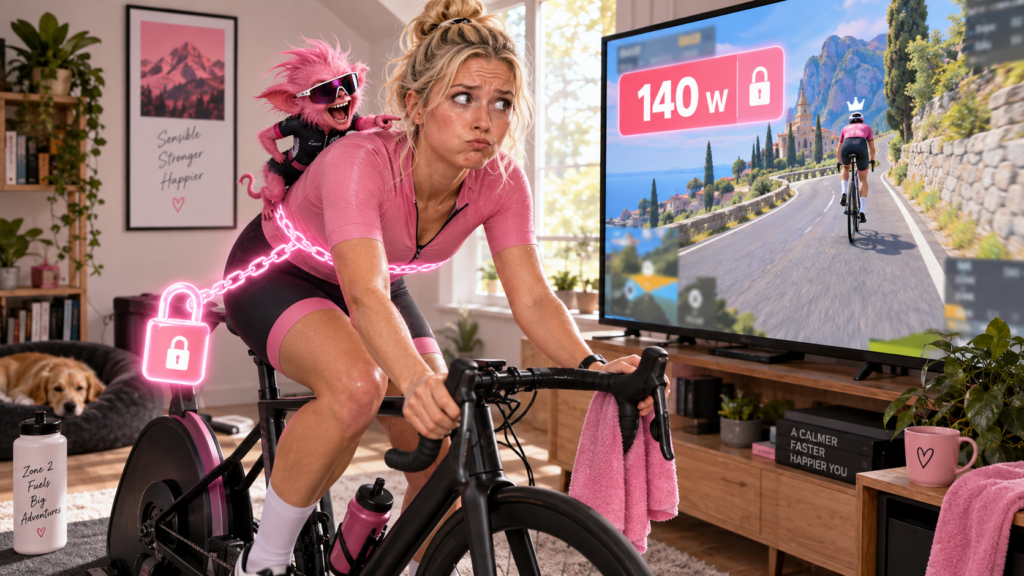
Watt Lock is an ERG mode toggle you can switch on during an ordinary free ride, straight from the Zwift Action Bar. You pick a power target, click, and your trainer holds you there. No matter what the road does. No matter who goes past you.
If you have only ever used ERG mode inside a structured workout, this is the same idea, just unhooked from the workout. Your trainer automatically sets the resistance so that power stays pinned to the number you chose, and you simply keep the pedals turning.
Zwift’s own line for it is “now Zone 2 days, stay Zone 2”, which honestly tells you everything about who they built it for.
If you are riding with a Zwift Ride, Zwift Click, or Zwift Play controller, you can also nudge the target up or down while riding, without stopping to fiddle with a laptop balanced on a chair. That part matters more than it sounds. Anyone who has tried to change a setting mid-ride with sweaty hands knows why.
Why this is quietly a big deal
Here is the problem it solves, and it is a very real one for anyone training around a full life.
Easy rides are supposed to be the boring backbone of your training. They build the engine. They let the hard days actually be hard. Every coach on earth will tell you that most of your riding should sit in that low, chatty, slightly-dull zone.
And yet almost nobody does it properly, because staying easy requires discipline that a dark winter morning and a competitive streak will happily override. Until now, the only reliable way to force yourself to hold steady low power on Zwift was to build or find a structured workout. Which means you lose the fun bit. No social ride. No exploring a route you have not done before. No chatting on the group ride. Just you, a graph, and a countdown.
Watt Lock removes that trade-off. You can join a social ride, follow a route, enjoy the scenery, and still come out the other end with a well-controlled session rather than another accidental hard day.
The hardest part of an easy ride has never been the effort. It has been the self-control.
What Watt Lock will not do
This is the honest bit, and it is worth understanding so you do not expect the wrong thing.
Watt Lock holds a power number. It does not hold a heart rate zone.
Those two things feel similar, but they are not the same. Your power output at 140 watts is the same on every single ride. Your heart rate at 140 watts is not. It drifts upward over a long session. It sits higher when you are tired, dehydrated, under-slept, stressed, or riding in a hot room with a rubbish fan. It behaves completely differently in February than it does in July.
So Watt Lock will keep you honest about your effort, but it will not automatically keep you inside a heart-rate zone. If your zones are set off heart rate rather than power, you will still need to glance at the number and adjust the target yourself. Which, happily, is exactly what the controllers are for.
Worth noting: the comments under the announcement are full of people asking for heart-rate-controlled resistance as the next step, which tells you the demand is there. That is community chatter though, not a promise from Zwift and not a survey. Treat it as a maybe, not a roadmap.
Four ways I am actually going to use it
Once I stopped being excited and started being practical, these are the sessions I think it genuinely fixes.
- Actual Zone 2, on a route I like. Pick a flat-ish route, lock the watts, put on a podcast, and ride. The session stays easy even when the terrain does not.
- Social rides without the surprise sprint. Group rides are lovely right up until the pace ramps and pride takes over. Lock it, and you get the company without the cost.
- Recovery days that stay recovery days. The easiest training day to ruin is the one that is meant to be gentle. This makes “gentle” the default rather than the goal.
- Coming back from a break or an injury. When you are rebuilding, the fastest way to undo progress is to go too hard too soon. A locked ceiling is a kinder coach than willpower.
If you are new to all of this and the phrase “Zone 2” is doing a lot of heavy lifting here, start with the beginner’s guide to Zwift, then your first four weeks on Zwift. Watt Lock will make a lot more sense once you have a few structured rides under your belt.
A practical test I want to run
My planned test, as of 18 September 2026, was to do the same forty-five-minute route twice. Once as a normal free ride with my usual good intentions, and once with Watt Lock switched on at the same target.
Then I will compare the two: average power, normalized power, how much time I actually spent in the zone I said I was riding in, average heart rate, and how I felt the next morning. My honest prediction is that the free ride will show a lower average power but a much messier spread, more time above zone than I would like to admit, and worse legs the following day.
I will report back, including the numbers I am not proud of. 😅
🚴♀️ Want your training to actually stick?
Watt Lock will hold your watts, but it will not plan your week for you. The digital trackers, planners, and checklists in the shop are built for exactly this — real training around a real life, with space for the days that do not go to plan.
The rest of the September 2026 announcement
Watt Lock is part of a fairly full season announcement, so while you are here, the bits worth knowing:
- Watopia expansion, 26 October — roughly 18 km of new roads inspired by the Californian coast and Catalina Island, connecting Jarvis to the Jungle. There is a flat bypass around the Epic KOM, which some of us have been quietly praying for.
- Tour of Watopia, 5 October to 22 November — back again with Double XP.
- Zwift Companion refresh, October — a cleaner home screen with your week and your progress easier to see.
- Game home screen update, from 22 September — planning and progress moved to the front, plus career progression stats.
- Zwift Ride V2 — already available, now fitting riders from 146 cm to 198 cm with adjustable cranks as standard.
You can read the full announcement on Zwift’s seasonal roadmap if you want the lot.
Final thoughts
Most feature announcements are noise. New bikes, new kit, new badges. Nice, but they do not change how you train.
This one might, and not because it is clever. It is genuinely simple. It just happens to solve a problem that a lot of us have been failing to solve with willpower for years, on the days when it is dark at 5am and the only window you have is forty-five minutes before everyone else wakes up.
If you have ever finished a “recovery ride” more tired than when you started, you can see why the October 2026 announcement caught my attention. 🩷

🩷The Endurance Diaries🩷