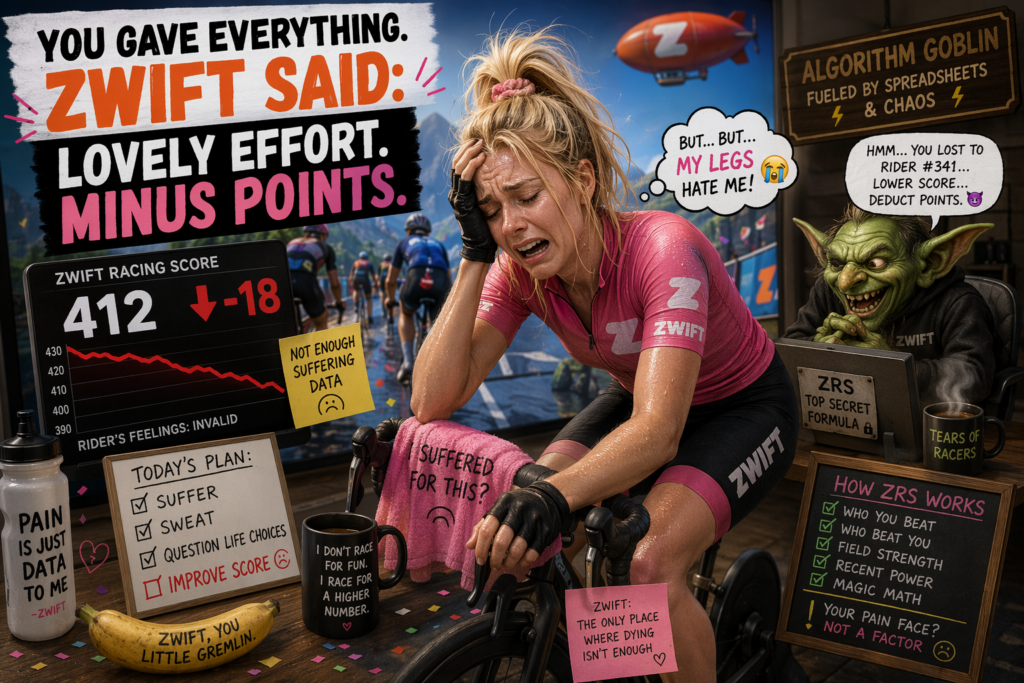
You crossed the line cooked. Your legs were making dial-up internet noises. Your heart rate was somewhere near “please contact emergency services.” And then Zwift looked at all that suffering and said:
“Lovely effort. Minus points.”
Rude? Yes. Personal? Probably not. Confusing? Absolutely. Welcome to the mysterious little goblin cupboard known as Zwift Racing Score — or ZRS.
The Hard Truth: A Hard Race Does Not Always Mean a Higher Score
This is the bit that catches most riders off guard.
Your Zwift Racing Score does not simply look at your pain face and award sympathy points. It is not standing at the finish line with a blanket, a banana, and emotional support glitter. ZRS is mainly about your performance relative to the riders around you.
That means Zwift looks at things like:
- Where did you finish in the race
- How strong the field was
- The Racing Scores of the riders who beat you
- The Racing Scores of the riders you beat
- Your recent power data
- Whether your older best efforts are still inside the scoring window
- Whether you have been racing regularly
So yes — you can race hard and still lose points. The algorithm is not asking, “Did this feel awful?” It is asking, “Who did you beat, who beat you, and what does that say about your current level?” Tiny violin. Big spreadsheet.
Reason 1: You Lost to Riders With Lower Scores
This is the big one. If you carry a higher Racing Score and finish behind riders with lower scores, Zwift may decide your score needs a little adjustment. Not a full buzz cut — more like a suspicious trim behind the ears.
Here is a quick example:
- You start with a score of 420
- Several riders around 360 finish ahead of you
- Zwift says: “Interesting. Very interesting.”
- Your score drops
This does not mean you are suddenly weaker. It may mean the race was tactical, you missed the right wheel, you got caught behind a split, the route did not suit you, the lower-score riders were simply stronger than their numbers suggested, or you were racing on tired legs. ZRS sees the result. It does not fully understand your tragic backstory from kilometre 17.
🚴♀️ New to Indoor Cycling or Zwift? Here’s What You Actually Need
Before you spend a fortune on things that sound important but turn out to be optional extras, here is the honest starter list. No fluff. No “invest in your journey” energy. Just the stuff you actually need to get pedalling.
🛠️ The Essentials (you cannot skip these)
- A bike — road, MTB, or even that thing gathering dust in the garage 🚲
- A smart trainer or turbo trainer — smart trainers control resistance automatically; basic turbos just hold your bike still while you suffer manually. Either works to start. Search Takealot | Search Amazon
- A laptop, PC, tablet, or Apple TV — to run Zwift. Older devices work fine. Your phone also works, but the screen will make you squint like you’re reading fine print in a wind tunnel.
- A Zwift account — free trial available at zwift.com. After that, it’s a monthly subscription. Worth it. Mostly.
- A fan — not optional. You will overheat faster than you expect. Any fan will do. The bigger the better. Borrow one from the kitchen if you must. Search Takealot | Search Amazon
- A mat under your trainer — protects your floor from sweat. Yes, it gets that sweaty. No, you are not special. Search Takealot | Search Amazon
- A sweat towel — you know why.
🎧 Nice to Have (upgrade when you’re hooked)
- Heart rate monitor — helps track effort and makes your Zwift profile look like you know what you’re doing. Search Takealot | Search Amazon
- Cadence or speed sensor — useful if your trainer doesn’t already broadcast this data. Search Takealot | Search Amazon
- Cycling shorts with a chamois — your backside will thank you after ride 3. Trust this advice. Search Takealot | Search Amazon
- A small table or riser for your screen — neck position matters more than you think. Anything that gets your screen to eye level works, including a stack of cookbooks.
- Cycling shoes + cleats — eventually you’ll want these. Not essential on day one. Search Takealot | Search Amazon
🇿🇦 SA-Specific Tip
Load shedding and Zwift do not get along. Consider a small UPS (uninterruptible power supply) or a laptop setup so a scheduled outage does not kill your mid-race effort right before the sprint. Ask me how I know. 🕯️ Search UPS on Takealot
All links above are provided for convenience — I am not sponsored by any of these retailers (yet 😅). Prices and availability vary, so always compare before you buy.
ZRS sees the result. It does not fully understand your tragic backstory from kilometre 17.
Reason 2: The Field Was Not Strong Enough to Reward You
Field strength matters a lot. If you race against a strong field and perform well, your score has more reason to climb. If the field is weaker, even a decent finish may not move the needle much.
This is why two races can feel completely different on the score sheet:
- Race A: You finish mid-pack against strong riders — your score goes up
- Race B: You finish mid-pack against lower-scoring riders — your score goes down
Same suffering. Different maths goblin. This is also why “I nearly died in that race” is not always the same as “I improved my score.” Zwift does not measure drama — which is unfortunate, because some of us would be Category A in race drama.
Reason 3: Your Old Power Bests Are Ageing Out
Your score is partly influenced by recent power data. If you once did a spicy 5-minute effort that made your bike question its career choices, that effort may have supported your score for a while. But if it ages out of the scoring window and your newer efforts are lower, your baseline can quietly drop.
This is not punishment. It is Zwift saying: “Show me who you are now, not who you were during that one heroic Tuesday when caffeine and chaos aligned.”
Annoying, but fair. Fitness changes. Fatigue changes. Training changes. Life changes. Your Racing Score shifts with that.
Reason 4: Score Decay After Inactivity
If you take a longer break from racing, Zwift can gradually reduce your score after a grace period. This is designed to stop returning riders from being thrown straight back into a group that no longer matches their current race sharpness.
It is not Zwift being mean. It is Zwift saying: “Welcome back. We have lowered the dragon slightly.” That actually makes sense. Nobody wants to return from a break and immediately be launched into a category where the first attack feels like being chased by a lawnmower.
Reason 5: Minimum Effort Thresholds
Zwift also wants race efforts to look like actual race efforts. If someone rolls around, hides, soft-pedals, or puts in very low effort relative to their expected ability, the system may not treat the result as useful evidence of fitness.
For riders who genuinely raced hard, this is usually not the main issue. But it is worth knowing: ZRS is not just about finishing position — it also looks for signs that the effort was meaningful. If your race file looks like you went to Watopia for a picnic, the algorithm may raise one eyebrow.
🚴♀️ New to Indoor Cycling or Zwift?
If you are just getting started with Zwift or want to set up your indoor cycling space properly, our Indoor Cycling Starter Pack covers everything — from gear and setup to your first 30 days on the platform. Made for South African riders, priced at R129.
What a Score Drop Does NOT Mean
Let’s clear something up before the doom spiral sets in. A score drop does not mean:
- You are getting worse
- Your training is broken
- You failed the race
- You should sell your smart trainer and take up competitive biscuit decorating
- You are doomed to be dropped forever
It simply means the result, field, and recent data nudged your score downward. Sometimes the score drops after a genuinely good effort because racing is messy. You can be fit and still lose the wrong wheel. You can produce great power and still finish behind lower-scoring riders who raced smarter on the day. Zwift racing is not a lab test — it is a digital street fight wearing Lycra.
What to Do After Your Score Drops
1. Look at who beat you
Were they lower-score riders who looked suspiciously strong? Did they attack at exactly the right time? Did you lose position before a key climb, sprint, or corner? This tells you whether the issue was fitness or race tactics.
2. Check the route
Flat races reward raw watts, drafting, and sprint positioning. Rolling routes reward repeatability and punch. Climby routes punish every extra biscuit you have ever loved. A lower score after the wrong route type does not mean disaster — it may just mean the course was not your playground.
3. Review your key moments
Ask yourself honestly:
- Where did the race split?
- Was I too far back going into the key section?
- Did I burn matches chasing gaps I should have let go?
- Did I sprint too early?
- Did I chase every attack like an overexcited sheepdog?
- Did I hide too much and miss the decisive move?
This is where the real improvement lies — not in the number itself, but in what the number points to.
4. Race consistently
One result does not define your level. Race regularly, recover properly, and your score will settle closer to reality. ZRS becomes far more useful when it has more good data to work with. One race is a snapshot. Several races are a story.
5. Keep your power profile fresh
You do not need to smash yourself every day, but it helps to include occasional race-like efforts in your training:
- Short VO2 intervals
- 30-second surges
- 3–5 minute hard efforts
- Sprint practice
- Over-under intervals
These help keep your power profile honest and race-ready — so Zwift has recent, quality data to work with rather than relying on old efforts that no longer reflect where you are.
The Bottom Line on ZRS
Your Racing Score dropping after a hard race can feel deeply unfair, but it almost always comes down to one thing: Zwift does not score your suffering. It scores your result against the field.
That means your score can drop if you lose to lower-score riders, race in a weaker field, have older power bests fall out of the window, return after inactivity, or produce an effort the system does not consider meaningful. The best response is not panic — it is analysis.
Look at the field. Look at the route. Look at where the race changed. Then train the weakness and race again. Because the number is useful, but it is not your identity. It is just a tiny digital referee with a calculator and absolutely no emotional warmth.
“Interesting performance. Please suffer again for more accurate data.” — Zwift, probably.
And because we are cyclists, we probably will. 🚴♀️

🩷The Endurance Diaries🩷