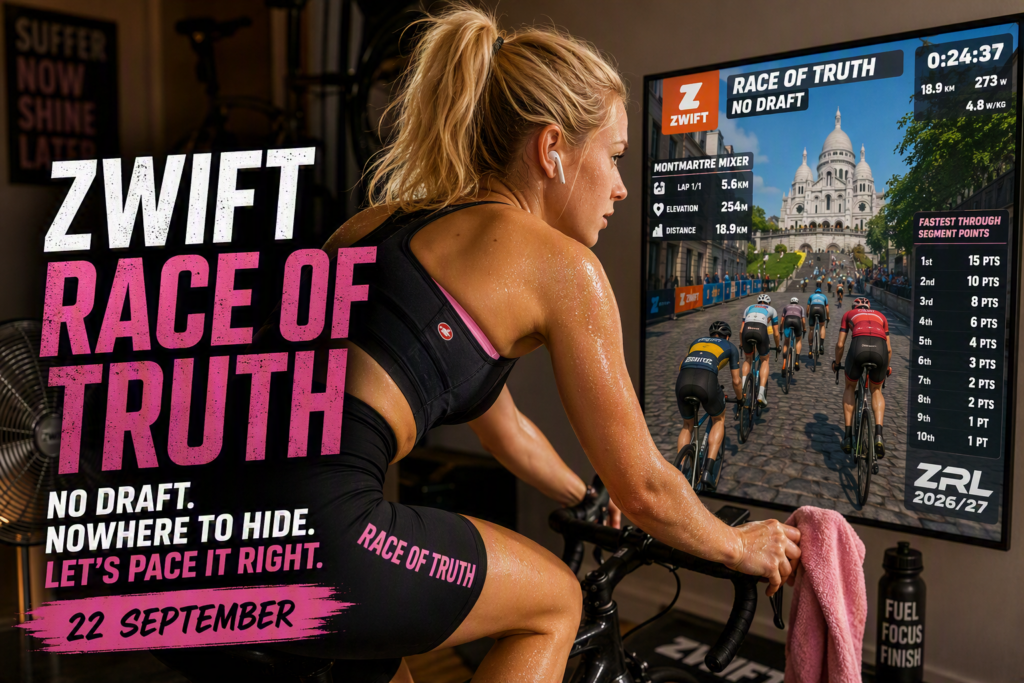
Tuesday 22 September. Mass start. Full field. No draft.
That last part is the whole story. Zwift and WTRL are opening the 2026/27 Zwift Racing League season with a brand-new format called the Race of Truth — a mass-start points race with drafting completely switched off. No wheel to sit on. No bunch to hide in. No quietly recovering at 180 watts while somebody else does the work on the front.
It is, as the name suggests, quite rude. And I say that as someone who captains a team and has spent many Tuesday evenings being extremely grateful for a draft.
The registration deadline for the September 2026 opener
This was the registration window for the September 2026 opener; check the WTRL page for current registration dates.
- Registration closes: 18 September 2026 at 23:00 UTC — which is 01:00 on Saturday morning our time. So in practice, Friday night is your cut-off.
- Round 1 starts: Tuesday 22 September 2026
- Round 1 runs: 22 September to 27 October (six weeks, themed “Fresh & Fast”)
- Race 1 format: Race of Truth on Paris’ Montmartre Mixer
Race times vary by league and time zone, so check your slot on the WTRL ZRL page rather than assuming it’s the same as last season. A few things moved around this year.
What else changed this season
The Race of Truth is the headline, but it isn’t the only thing that shifted:
- Smaller teams. Maximum ten riders per team, down from twelve, with five racing each week instead of six. Less bench, more pressure on whoever shows up.
- More riders score on segments. Fastest Through Segment points now go to the top ten times instead of the top five — 15 points for the fastest, sliding down to 1 point for tenth. That’s a meaningful change for mid-pack riders who never used to see a point all season.
- Four full six-week rounds, September through April.
- Steering is on for every ZRL race now, with braking available only in team time trials.
- 250 XP per lap completed, plus an in-game ZRL cap if you start at least one race in each of the four rounds.
- Road to ZRL introduction rides for anyone who’s curious but hasn’t raced in a league before. No racing, just a group ride that explains how the whole thing works.
New to indoor racing entirely? Start with the Zwift basics over here first — this article assumes you’ve already got a trainer, a fan and a working setup.
Why no draft changes absolutely everything
Here’s the thing most of us don’t fully admit: a huge amount of Zwift racecraft is draft management. Getting to the front before a climb. Sliding back to recover. Timing the surge so you pop out of the bunch with fresh-ish legs. Sitting in is dramatically easier than riding on the front, and a good chunk of “I had a great race” is really “I positioned well and got a free ride for twenty minutes.”
Take the draft away, and all of that disappears. Everyone is on road bikes — TT bikes are banned too — and from the gun it is just you, your power meter and roughly half an hour of honesty.
What it actually becomes is an individual time trial that happens to be scored inside a team competition. Your effort still feeds your team’s points. But nobody can carry you, and you can’t carry anyone else. Which is either liberating or horrifying, depending on how your last three weeks of training went.
The draft is where we hide our bad days. Take it away and the race stops being about tactics and starts being about whether you actually did the training.
The route: Montmartre Mixer, and those climbs
Round 1, Race 1 is one lap of Paris’ Montmartre Mixer — 27.6 km with 198 m of elevation. On paper, that’s gentle. It is not gentle.
The elevation isn’t evenly distributed along the route. It’s concentrated in back-to-back trips up Montmartre, which is short, steep, and cobbled, and which will absolutely find you if you’ve overcooked the flat sections. In a normal race, you’d bleed off the front group on the climb and claw your way back on the descent by drafting.
You can’t. There’s no clawing back. Whatever you lose on the climb, you own.
Realistically, that’s somewhere between 40 and 50 minutes of racing for most of us, depending on category and how the day goes. Plan your fuelling and your fan accordingly — this is long enough that going out too hot has time to properly punish you.
How to pace it without blowing up
This is the bit that matters. Six things I’d tell a teammate:
1. Survive the first five minutes
Everyone goes off like a scalded cat at the start of a Zwift race, because in a normal race you have to — miss the front group and your day is over. In a Race of Truth, that logic does not apply. There’s no group to miss. Going out at 130% of what you can hold just buys you a much worse second half. Let them go. You’ll see a lot of them again.
2. Know your number before you start
Decide on a target wattage in advance and write it on a sticky note on your screen if you have to. For an effort this long, most people can hold somewhere just below their threshold power on the flat sections. Work out what that is for you — from a recent test or a hard 20-minute effort you’ve actually done — not from what your teammate is pushing.
3. Ride the climbs slightly harder, not heroically harder
A small lift on the climbs and a small drop on the flats is genuinely faster over the whole route than pure even pacing. The keyword is small. Going 40 watts over your target up Montmartre feels amazing for ninety seconds and costs you the next ten minutes.
4. Pick your segments — don’t chase all of them
With FTS points now going ten deep, there’s real value in a targeted effort on a segment that suits you. But every segment you contest costs you something. Choose one, maybe two. Chasing every sprint and every climb in a no-draft race is how you end up walking your bike home at 25 km.
5. Talk to your team beforehand
You can’t help each other on the road, but you can absolutely divide up the work before the start. If one rider is a climber and one is a flat-road diesel, don’t both go for the same segment points. Five riders all targeting the same sprint is five riders splitting one result.
6. Set up your pain cave like it’s a time trial
Because it is one. Fan on before you start, not ten minutes in. A bottle within reach. Something with carbohydrate in it if the effort is going past about 45 minutes. A towel. You will not get an easy patch to sort any of this out mid-race — there aren’t any.
🚴♀️ Sorting out your indoor setup first?
If the fan-and-towel section made you realise your pain cave is held together with optimism, have a look through the shop. There’s a proper starter checklist in there — the honest version of what you actually need, without the “invest in your journey” nonsense.
The week you actually have
When I wrote this on 15 September 2026, the race on 22 September was seven days away. Here was my suggested build for that week:
- Early in the week: one session of longer threshold blocks. Something like 3 × 10 minutes at a hard-but-sustainable effort, with easy spinning in between. The point isn’t to build fitness in a week — it’s to remind your legs and your head what that effort feels like from the inside, so you recognize it on race day.
- Mid-week: a short set of sharp efforts. A handful of 30-second hard accelerations with full recovery between each. Keeps you feeling snappy without digging a hole.
- Do a recon lap of Montmartre Mixer at an easy pace. WTRL runs recon rides, or just ride the route yourself. Knowing where the climbs arrive is worth more than any session this week.
- Two days before: easy. Genuinely easy. Not “easy but I felt good so I did a Zwift race”.
- Day before: short spin with two or three 1-minute efforts at race pace. Then leave it alone.
Standard caveat: this is what works for me and my team, not a prescription. You know your own body, your own recovery, and whether you’re carrying anything. Adjust or skip it entirely and just show up.
The honest bit
Opening a season with a no-draft race is a bold call, and I don’t think it’s an accident. Draft racing rewards positioning, reaction time, and, to be blunt, having a good connection and a fast finger on the powerup. Race of Truth rewards none of that. It rewards showing up having done the work and then pacing it like a grown-up.
Which means a lot of riders are going to finish this one with a result that doesn’t match the one they’re used to. Some will be much better than expected. Some will be humbling. Both are useful pieces of information and are still worth points for your team.
My plan when I wrote this was to be there on Tuesday 22 September 2026, going out too hard in the first five minutes despite writing an entire article telling you not to. Come say hi. Or rather — come suffer quietly in your own separate bubble of air, three bike lengths away, because that’s the format now.
Good luck. Set the fan on high. 🩷

🩷The Endurance Diaries🩷