Let me describe a week to you, and you tell me if it sounds familiar.
Monday: you jump on Zwift, hold your race power like it’s nothing, and finish wondering why you ever doubted yourself. You are a machine. 🚴♀️
The following Monday: same trainer, same route, same legs… and you can barely hold your warm-up number. Your heart rate is through the roof. You feel like you’ve aged ten years in seven days, and you spend the whole ride quietly wondering where your fitness went.
Here’s the thing nobody told us: that’s not a fitness problem. That’s your hormones. And once you understand the pattern, you can stop fighting it — and start training with it.
Your power isn’t broken — your hormones are doing their thing
Most of the training advice we’ve absorbed over the years was built on studies done on men. Men have a fairly steady hormonal baseline day to day. We don’t. Across roughly 28 days, our oestrogen and progesterone rise and fall in a predictable pattern — and those shifts genuinely change how our bodies respond to a hard effort.
This isn’t woo. Research published in Clinical Physiology (Moran et al., 2000) tracked women’s resting heart rate, blood pressure, and a cardiovascular fitness index across hormonally defined cycle phases. The findings were clear: your heart genuinely works harder at certain points in your cycle, even at rest.
Your “off” week often isn’t an off week at all. It’s just the wrong week to expect a PB.
The four phases, in plain Zwift terms 🚴♀️
Let’s skip the textbook and talk about what each phase actually feels like on the trainer.
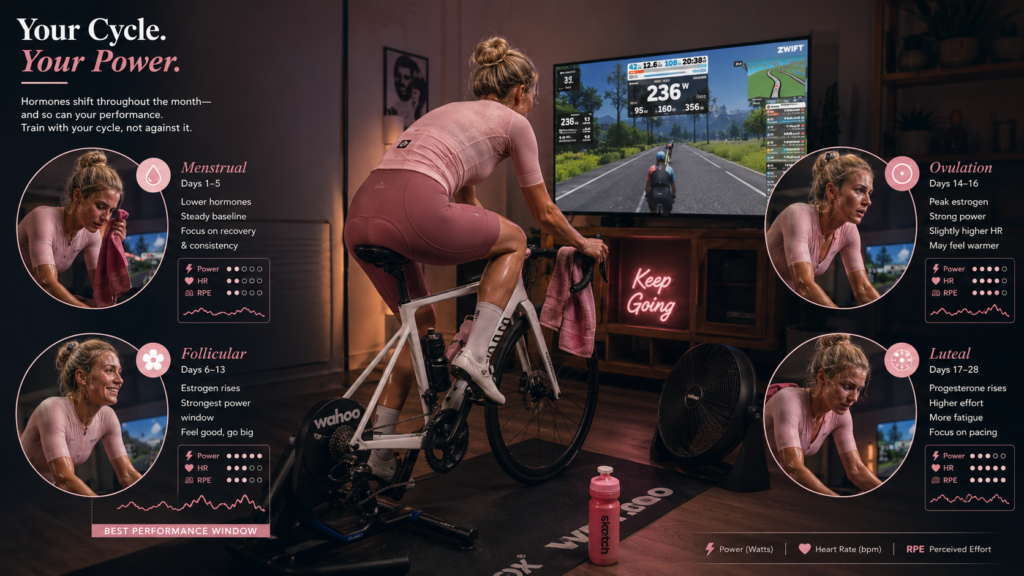
🔴 Menstrual phase (days 1–5) — your baseline
Your period arrives, and hormones are low. Here’s the surprise: research found that resting heart rate is actually at its lowest in this phase. So while the first day or two might feel rough thanks to cramps and fatigue, your cardiovascular system isn’t under hormonal stress. A gentle Zone 2 spin or a social ride on a flat Watopia route is often more doable than you’d expect. Don’t force a race on a heavy day — but don’t write the whole week off either.
🌱 Follicular phase (days 6–13) — your power window
This is the good stuff. As oestrogen levels rise, the cardiovascular fitness index in the study peaks. Your resting heart rate stays low, so the same watts cost you less. This is when you feel like a machine — and it’s not your imagination. If you can choose when to race or chase a power PB, this is the week. Book your hard intervals, your crit races, your KOM attempts here.
⚡ Ovulation (days 14–16) — strong, but warmer
Oestrogen peaks and your resting heart rate climbs significantly. Your power can still be good, but your heart rate readings will look higher than you’re used to — your monitor isn’t broken; it’s hormones. You’ll also run a little warmer, so crank that fan. One to know: the oestrogen surge increases connective tissue laxity, so warm up properly and be a bit more careful with sudden, sharp movements.
🌙 Luteal phase (days 17–28) — the furnace
Progesterone rises, and that’s when things get sweaty. Your core temperature goes up by up to half a degree, your resting heart rate is significantly elevated, and you genuinely feel like you’re working harder at the same power. Add the late-cycle fatigue and cravings, and this is your phase for Zone 2, recovery rides, and beautiful long spins through Makuri Islands — not for chasing numbers you set two weeks ago.
So what do you actually do with this?
You stop comparing this week’s ride to last week’s, as if your body were a fixed machine. You schedule your hard efforts in your follicular window, you protect your luteal phase for easier riding, and you give yourself a break when your heart rate spikes for no apparent reason — because now you know the reason.
The catch? Doing this in your head is almost impossible. You’d need to track your cycle, know which phase you’re in today, remember what the research says about it, and match it to your training. That’s a lot of mental admin on top of a full life and an Eskom schedule. 🕯️
So I built something to do it for you.
🩷 The Cycle Performance Tracker
An interactive tool you open in any browser that shows you exactly which phase you’re in, how it affects your training today, and what to do about it. It’s got a colour-coded calendar, a built-in “Ask TED” assistant for your questions, a feelings tracker, a training log, and the real research behind every phase. No subscription, no login, works offline — pay once and keep it forever.
Your cycle isn’t the enemy
For years, I treated my own bad weeks as a personal failing — proof I was lazy, or losing fitness, or just not trying hard enough. I wasn’t. I was riding straight into my luteal phase expecting follicular-phase numbers, only to beat myself up when they didn’t come.
Once you can see the pattern, everything softens. The strong weeks make sense. The flat weeks are no longer a crisis. And you get to work with the most powerful piece of training data you already own.
Your cycle isn’t a problem to push through. It’s information. Let’s use it.
A quick, honest note: this is an educational and planning tool based on published research, not medical advice. Every woman’s cycle is different — always listen to your body, and chat to a healthcare provider for anything medical.
Got a question about training around your cycle, or want to tell me about your own machine-week-then-mud-week experience? I’d genuinely love to hear it — drop me a message at hello@theendurancediaries.co.za or come find me on the socials. 🩷

🩷The Endurance Diaries🩷