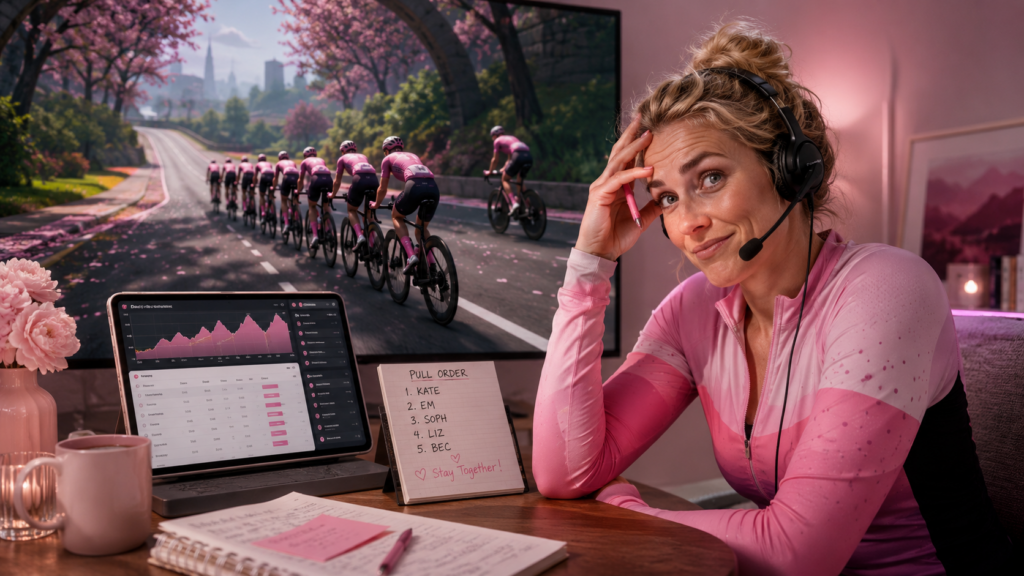
There is a moment in every TTT where the DS realises they’ve made a terrible mistake. Maybe it’s when the team is strung out like washing on a line, and nobody is responding to the voice chat. Maybe it’s when you call a push on a climb and half the team quietly disappears off the back. Maybe it’s when you check the splits and realise the team behind you, who looked slower in warm-up, is now 12 seconds ahead.
That moment? I’ve had it. Multiple times. Usually followed by a very calm, very professional: “Okay guys, we’re going to be fine.” (We were not fine.)
If you’ve ever volunteered — or been voluntold — to DS for your Zwift TTT team, this one is for you. Here’s how to know you’re not doing it well, and more importantly, what to actually do about it. 🩷
Wait — What Does a TTT DS Actually Do?
For anyone still learning the lingo: DS stands for Directeur Sportif. In a real-world cycling race, the DS is the person in the team car who yells tactical advice through a radio earpiece while eating a croissant and stress-reading weather forecasts.
In a Zwift TTT, the DS is the person who sits in fan view — not actually racing — and calls the race over Discord while everyone else suffers. According to Zwift Insider, the job involves knowing the course, managing the pull order, watching the splits, and making quick tactical calls about when to push, when to recover, and whether to chase a split or let it go.
In theory: calm, strategic, vital.
In practice, a person narrates chaos while everyone ignores them. 😅
Signs You’re Not a Good DS
Let’s be honest with ourselves. Here are the signs. Tick the ones that apply. Do not show this list to your teammates.
🚩 You don’t know the course before the race
A good DS studies the route in advance — flat sections, climbs, descents, where the team is likely to fracture. If you opened the race event and thought “right, I’ll just see what happens,” you were not ready. The DS is supposed to be the one person in the group who isn’t surprised by the hill. You. You were surprised by the hill.
🚩 You have no pull order planned
The pull order should be worked out before the race starts, ideally using a tool like the Zwift TTT Calculator, which takes each rider’s FTP to calculate appropriate power targets and turn lengths for each position. If your “plan” was “everyone just take turns when it feels right,” then respectfully, that is not a plan. That is a wish.
🚩 You’re calling turns while the team is already past the point
Timing is everything in DS communication. If your call of “okay, swap now!” arrives about 8 seconds after the moment has passed and the team has already done whatever they were going to do anyway, you are providing commentary, not direction. There is a difference.
🚩 You can’t read the gaps
If you don’t know whether the team 15 seconds ahead is catchable or whether that gap is growing, you cannot make good calls. Tools like Sauce for Zwift in fan view help enormously here. Without data, you’re guessing. Guessing loudly is still guessing.
🚩 You panic-pushed on the climb
There is a special kind of bad DS call that sounds like this: “Okay, the climb is coming, let’s go, let’s push it!” — delivered with enthusiasm, no pacing context, and a complete failure to account for the fact that three of your riders were already on the limit. The group’s subsequent explosion was technically your fault. We don’t say this to be mean. We say it because we have been that DS.
🚩 You’re talking constantly but saying nothing useful
There is a version of DS where every 10 seconds you say something — “Looking good, guys!” “Keep it smooth!” “Almost there!” — and none of it is actionable. Your team is at 110% of FTP, trying to breathe. They do not need encouragement. They need specific information: who pulls next, how long, and whether to back off. Give them that.
How to Actually Get Better at It
The good news is that DS is a learnable skill. Here is what actually helps.
📋 Study the course before the race
This is the single most important pre-race task. Know the route. Note where the climbs are, where the descents offer recovery, and where the team is most likely to fracture. Zwift Insider’s DS guide recommends noting flat sections, undulating sections, longer climbs, and recovery opportunities so that when you’re in the middle of the race, you’re not narrating the terrain — you’re anticipating it. Riders on the limit cannot think ahead. You can. That’s your job.
📊 Use the TTT Calculator for your pull order
There are tools built specifically for this. The Zwift TTT Calculator takes each rider’s FTP and works out recommended power targets and pull lengths by position. Stronger riders pull longer. Weaker riders pull shorter or stay in the draft if the gap in ability is more than about 20% below the team average. If you’re winging it based on vibes, you’re leaving time on the table.
⏱️ Calls need to be clear, short, and early
Your voice calls need to be specific and timed about 5–10 seconds before the action. “Sarah, 30 seconds on the front, then swap to Marco” is a useful call. “Okay, maybe think about swapping soon, whatever feels right” is not. Your riders are not in a position to interpret ambiguity. Short, named, specific, early. Every time.
👁️ Use fan view and the right tools
As the DS, you’re in fan view — not riding. Make the most of it. The Zwift fan view gives you gap information to teams ahead and behind. The WTRL website sometimes shows live updates too. Your job is to be the eyes the riders can’t afford to use while they’re trying not to die. Use every tool available to see the race clearly.
🧠 Know when to chase and when to let go
One of the hardest DS decisions is whether to push to close a split within the team or to let a dropped rider go and keep the remaining group moving. General wisdom: if the gap is small and closing, chase. If the group has to blow up to close it, keep the train moving. This is painful to call. But a splintered group chasing a dropped rider often ends with everyone suffering and nobody benefiting. Protect the group.
🎧 Sort your comms setup before race day
Discord is the standard. Make sure the team is on the channel, that push-to-talk is set up if needed, and that you’ve done a quick sound check before the race. There are few things more deflating than the team going off the front while you’re still trying to unmute yourself. Technical failures during a race are fixable. Technical failures at the start are embarrassing.
The TTT DS Mindset Shift
Here is the thing nobody tells you when you take on the DS role: you are not there to motivate. You are not a cheerleader. You are not a commentator.
You are an information service.
The riders are on the limit. Their brains are partially offline. They need to know who pulls next, how long, whether to go harder or back off, and whether anything is coming up they need to prepare for. That is it. Everything else is noise.
When you start thinking of yourself as a precision information service rather than an enthusiastic team manager, the calls get cleaner, the communication tightens, and the team actually starts to trust your voice.
“A good DS is heard when needed and invisible when not. The goal is not to be the voice of the race — it’s to be the information that makes the difference.”
One Last Honest Thing
Being a bad DS does not mean you are a bad person. It usually just means you took on the role without anyone explaining what it actually involves. Most Zwift teams figure this out the hard way — after a race where the comms fell apart, the pulls were uneven, and someone ended up dropped on a climb that was on the map the whole time.
The TTT is one of the best things about Zwift racing. It rewards preparation, communication, and teamwork in a way that solo racing never can. And when it clicks — when the team is smooth, the turns are timed perfectly, and the calls are landing right — it is genuinely one of the most satisfying experiences on the platform.
So yes, I have been a mediocre DS. I am working on it. And now, apparently, so are you. 🩷
🚴♀️ New to TTT Racing or Zwift in General?
If you are still figuring out your indoor cycling setup, the Endurance Vault has practical resources to help you get started — without the overwhelm or the need to spend a fortune before you know what you actually need.
Questions, TTT horror stories, or tales of accidental DS redemption? Drop me a note at hello@theendurancediaries.co.za — I genuinely love hearing from fellow sufferers. 🩷

🩷The Endurance Diaries🩷